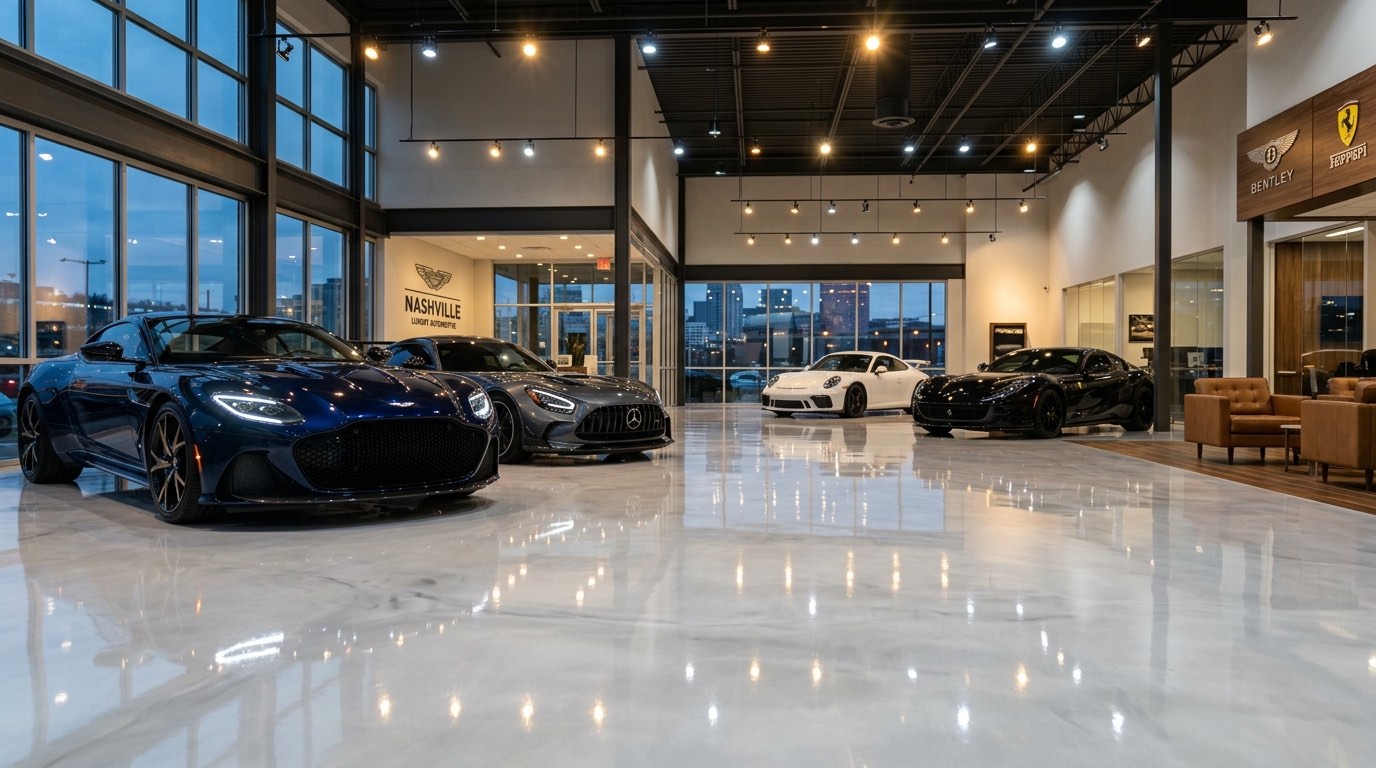
Nashville's automotive sector - from the Brentwood and Franklin dealership corridors to body shops along Gallatin Pike and Murfreesboro Road - specifies epoxy flooring differently from residential garages. The chemical environment, the traffic loads, and the appearance requirements all vary by facility type, and specifying the wrong system leads to early failure. This guide covers what Nashville dealership showrooms, service bays, and auto body shops each require from a floor coating, and what those systems cost.
Why Nashville Automotive Facilities Require Industrial Epoxy Flooring
Standard residential epoxy garage floors are formulated for passenger car traffic, low chemical exposure, and moderate UV from garage door openings. Automotive epoxy flooring Nashville specifications go considerably further because automotive facilities expose floors to:
- Motor oil, transmission fluid, brake fluid, power steering fluid - all penetrate inadequately sealed concrete and degrade standard topcoats over time
- Hot tire transfers - vehicles driven off transport trailers or out of service bays have hot tires that delaminate standard epoxy topcoats
- Forklift and parts cart traffic - wheel loads concentrated on small contact patches that exceed what residential systems tolerate
- Body shop solvents - thinners, primers, and body filler solvents attack standard epoxy chemistry; aliphatic topcoats required
- High-pressure steam cleaning - thermal shock from hot water that cracks inadequately flexible coatings
Dealership Showroom Epoxy vs Service Bay Epoxy: Different Requirements
Nashville automotive dealerships typically have two distinct floor environments that require different specifications under the same roof:
Chemical Resistance Specifications for Nashville Auto Body Shops
Auto body shops present the most demanding epoxy flooring specification of any Nashville automotive facility. The chemical inventory of a body shop - lacquer thinner, acetone, MEK, polyester body filler catalyst, epoxy primer, urethane clear coat - includes solvents that attack standard epoxy chemistry within months.
Standard 100% solids epoxy fails in body shop environments because:
- Aromatic epoxy chemistry is solvent-sensitive - lacquer thinner and MEK soften and cloud aromatic topcoats
- Body primer overspray settles on floor surfaces and bonds to uncured standard topcoats
- Paint booth floors need full chemical resistance plus conductive grounding for static dissipation
The correct Nashville body shop floor specification is 100% solids epoxy base coat + broadcast aggregate + aliphatic polyurea or polyaspartic topcoat. Aliphatic chemistry resists the full solvent spectrum in body shop environments, is UV stable against yellowing from spray booth lighting, and cleans with standard shop solvents without degrading.
Paint booth note: Nashville auto body shop paint booths require ESD (electrostatic dissipative) or conductive floor coatings for static grounding compliance, not standard epoxy. Specify an ESD system from a supplier with certification documentation - your insurer will require it.
Nashville Automotive Epoxy Flooring Systems and Specifications
| Facility Type | Base Coat | Broadcast | Topcoat | Key Spec |
|---|---|---|---|---|
| Dealership showroom | 100% solids epoxy | None or micro flake | Aliphatic polyaspartic | UV stable, high-gloss, vehicle reflection |
| Service bay | 100% solids epoxy | Quartz broadcast | Polyaspartic | Chemical resistance, anti-slip, hot tire |
| Auto body shop | 100% solids epoxy | Quartz broadcast | Aliphatic polyurea | Solvent resistance, UV stable |
| Paint booth | ESD epoxy primer | Conductive aggregate | ESD topcoat | Static dissipation, solvent resistance |
| Parts warehouse | 100% solids epoxy | Quartz or flake | Polyaspartic | Forklift traffic, OSHA floor marking |
Automotive Epoxy Flooring Cost Nashville: Dealership and Body Shop Pricing
| Facility Type | System Spec | Cost / sqft |
|---|---|---|
| Dealership showroom | High-gloss solid or metallic + aliphatic topcoat | $5–$9 |
| Service bay | Quartz broadcast + polyaspartic chemical-resistant topcoat | $4–$7 |
| Auto body shop | 100% solids epoxy + aliphatic polyurea topcoat | $6–$10 |
| Paint booth (ESD) | Conductive primer + ESD topcoat | $8–$14 |
| OSHA floor marking | Applied over cured epoxy, per linear foot | $3–$6/lf |
Volume pricing applies for Nashville automotive facilities over 5,000 square feet. Most dealerships coordinate installation during off-hours or weekends to avoid disrupting service bay operations. ProEpoxy Nashville schedules overnight and weekend installs for commercial automotive customers.
Hot tire warning: Standard residential epoxy topcoats fail under vehicle tires driven directly off transport trailers or out of service lifts. These tires reach 120–160°F - well above the heat deflection temperature of standard topcoats. Specify polyaspartic or polyurea topcoats for any Nashville automotive floor that will see vehicles driven on it within hours of sitting.
Automotive Epoxy Flooring Nashville - Common Questions
Get a Specification Quote for Your Nashville Automotive Facility
ProEpoxy Nashville provides written floor coating specifications for automotive epoxy flooring Nashville projects - showroom, service bay, body shop, and parts warehouse - with separate per-area specifications and pricing. We work with commercial epoxy flooring Nashville and warehouse epoxy flooring Nashville customers throughout the metro area. Request your Nashville automotive epoxy specification quote - includes product data sheets, system specs, and written warranty terms.