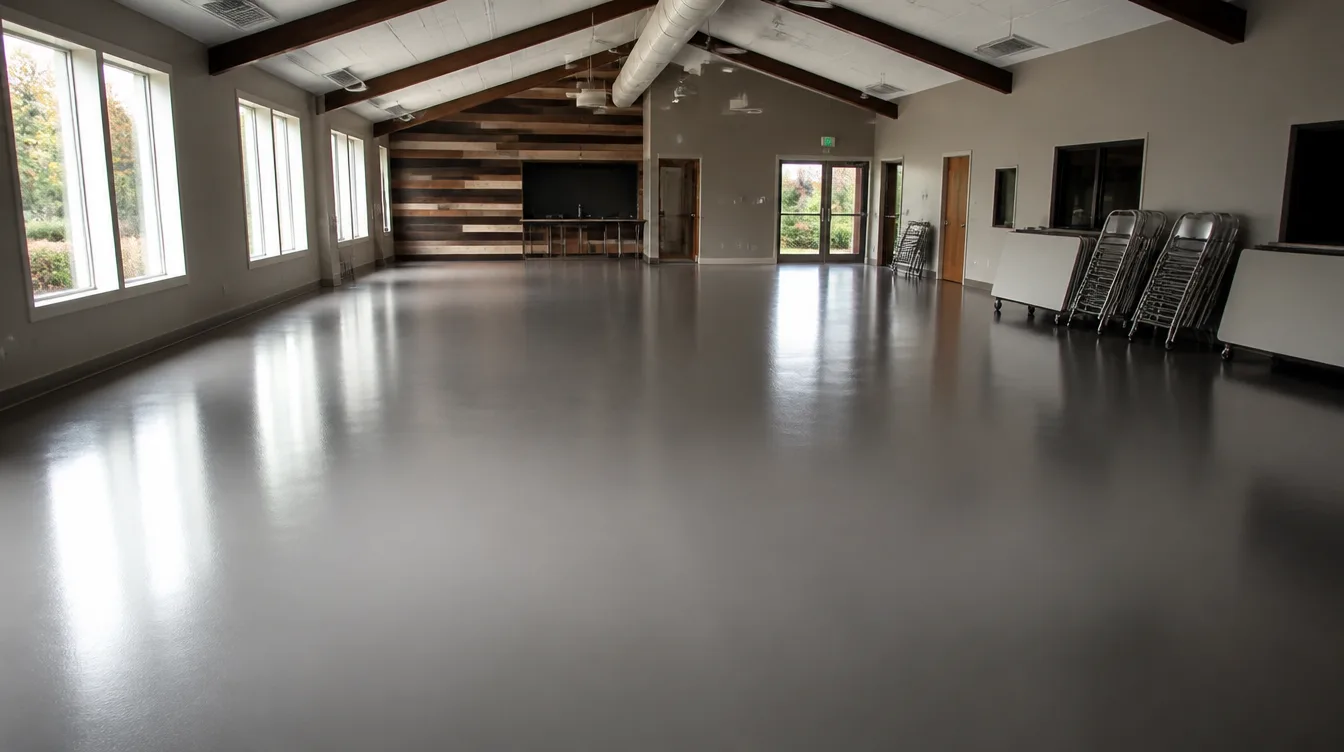
Commercial epoxy flooring for Nashville churches and religious facilities has to solve a problem few other building types face: an incredibly wide range of uses under one roof, often within the same room on different days of the week. A fellowship hall might host a potluck dinner Sunday afternoon, a youth basketball scrimmage Wednesday evening, and a community blood drive on Saturday — and the floor needs to handle all of it without looking worn or requiring specialized cleaning between each use.
Whether you're planning new construction for a growing congregation in Mt. Juliet or renovating a decades-old fellowship hall in an established Nashville church, epoxy has become the standard specification for exactly this kind of demanding, multi-use flexibility.
Multi-Use Space Flooring Challenges for Nashville Churches
Church facilities are unusual in how much functional variety a single space typically needs to support. The same fellowship hall floor that hosts folding tables and chairs for a Wednesday night dinner might need to be cleared for a children's activity, a memorial service reception, or a community outreach event the very next week. Few commercial flooring materials handle this range of use as gracefully as a properly specified epoxy system.
Carpet, a common older choice in church common areas, struggles with spills, heavy furniture legs, and the sheer volume of foot traffic a busy congregation generates. Tile handles durability reasonably well but its grout lines become a maintenance burden over years of heavy use, and a cracked or chipped tile is a visible, ongoing repair issue. Epoxy's seamless surface avoids both problems.
Fellowship Hall and Kitchen Applications
Fellowship halls are the highest-traffic, highest-variety spaces in most church buildings, and epoxy's durability and easy-clean surface make it particularly well suited here. A properly installed epoxy floor resists scuffing from folding table and chair legs being set up and broken down weekly, handles spilled food and drink without staining, and cleans up quickly between the many different events a fellowship hall typically hosts in a single month.
Church kitchens deserve particular attention, since many host regular community meals, potlucks, or even licensed food-service operations. An NSF-compliant epoxy or polyaspartic system meets the same food safety standards required of any commercial kitchen, and the seamless surface eliminates the grout lines and seams that make sanitizing a busy kitchen floor so labor-intensive with tile. For churches running an active food ministry or commercial-scale kitchen, our restaurant epoxy flooring Nashville page covers the same NSF-compliant systems in more depth.
Gymnasium and Multi-Purpose Room Applications
Many larger Nashville churches include a gymnasium or multi-purpose activity room used for youth sports, community events, and overflow gathering space. These rooms need a different specification than a fellowship hall — more emphasis on slip resistance for athletic activity, and enough durability to handle basketball, volleyball, and other sports without excessive wear.
Facilities running an active youth sports or fitness ministry program might also find useful parallels in our guide to commercial epoxy flooring for Nashville gyms and fitness centers, since the durability and slip-resistance priorities for a church gymnasium closely mirror a standalone athletic facility.
Budget-Friendly Phased Installation Options
Church facilities budgets typically operate on annual cycles or capital campaign timelines rather than a single large renovation budget, which makes phased flooring installation a practical and common approach. Rather than committing to a full-building renovation at once, most churches prioritize the highest-traffic or highest-need area first — often the fellowship hall or kitchen — and phase additional spaces across subsequent budget years.
| Phase | Typical Priority Area | Rationale |
|---|---|---|
| Phase 1 | Fellowship hall / kitchen | Highest traffic, most visible to congregation and visitors |
| Phase 2 | Gymnasium / multi-purpose room | High-use youth and community space |
| Phase 3 | Hallways / classrooms | Lower urgency, addressed as budget allows |
A phased approach also allows scheduling installation around the church's active calendar, minimizing disruption to weekly services and programming rather than closing the entire facility at once. For churches also managing or planning industrial-scale food service or storage space, our guide to commercial epoxy flooring for Nashville cold storage and food processing covers the same sanitation-first principles at a larger operational scale.
See our commercial epoxy flooring Nashville page for the full range of systems we install across church fellowship halls, kitchens, and multi-purpose spaces.
Design Considerations for a Welcoming Worship Environment
Beyond pure durability, most churches want their common spaces to feel warm and welcoming rather than institutional. Epoxy offers considerably more design flexibility than people often assume, with color and finish options that can complement a church's existing interior design rather than reading as a purely utilitarian commercial surface.
Neutral gray and warm beige tones tend to work well in fellowship halls and lobbies, creating a clean, bright backdrop that doesn't compete with signage, artwork, or seasonal decorations. Some churches opt for a decorative flake blend that adds subtle visual interest without the boldness of a metallic finish, which tends to read as more appropriate for a family-oriented gathering space than for a commercial showroom.
A practical design tip: Consider matching your fellowship hall floor tone to your sanctuary's existing color palette if the two spaces are visually connected through open doorways or shared hallways, creating a more cohesive feel throughout the building.
Long-Term Value for Church Facilities Budgets
Church facilities committees managing tight, donation-dependent budgets benefit significantly from epoxy's long service life compared to carpet or tile. A properly installed epoxy floor typically lasts 15 to 20 years with routine maintenance, meaning a single flooring investment can serve a congregation through multiple building seasons without the recurring cost of carpet replacement every 5 to 10 years.
| Flooring Type | Typical Lifespan | Replacement Cost Impact |
|---|---|---|
| Carpet | 5-10 years | Recurring cost every budget cycle |
| Tile | 10-15 years | Grout/tile repair costs accumulate over time |
| Epoxy Coating | 15-20+ years | Single investment, minimal ongoing cost |
This longer replacement cycle matters especially for churches that rely on capital campaigns or building fund donations to finance major facility improvements — a flooring investment that lasts through multiple campaign cycles delivers considerably more value per dollar than one that needs to be re-funded and re-installed every several years.
Facilities committees evaluating flooring options as part of a broader building improvement plan should also weigh the maintenance labor savings: volunteer or part-time facilities staff spend far less time on epoxy's simple mop-and-clean routine than on carpet vacuuming, spot treatment, or periodic tile grout cleaning, freeing up limited staff and volunteer hours for other ministry priorities.
New Construction vs Renovation Considerations
Churches planning new construction have an advantage over those renovating an existing facility: epoxy can be specified directly onto a properly poured and cured new slab without the complications that sometimes arise in older buildings, like existing adhesive residue, uneven wear patterns, or moisture issues in a decades-old foundation.
Renovation projects in older Nashville church buildings still work well with epoxy in the vast majority of cases, but typically require a more thorough surface assessment first — removing old flooring materials, addressing any cracks or moisture concerns in the existing slab, and confirming the substrate can achieve proper diamond-ground surface profile before coating. Building committees planning a renovation should budget time and cost for this assessment phase rather than assuming installation can begin immediately once old flooring is removed.
Either way, working with a contractor experienced in commercial and institutional projects — not just residential garage floors — matters for a church project specifically, since the scheduling flexibility, code compliance knowledge, and larger-scale material handling required differ meaningfully from a typical homeowner job.