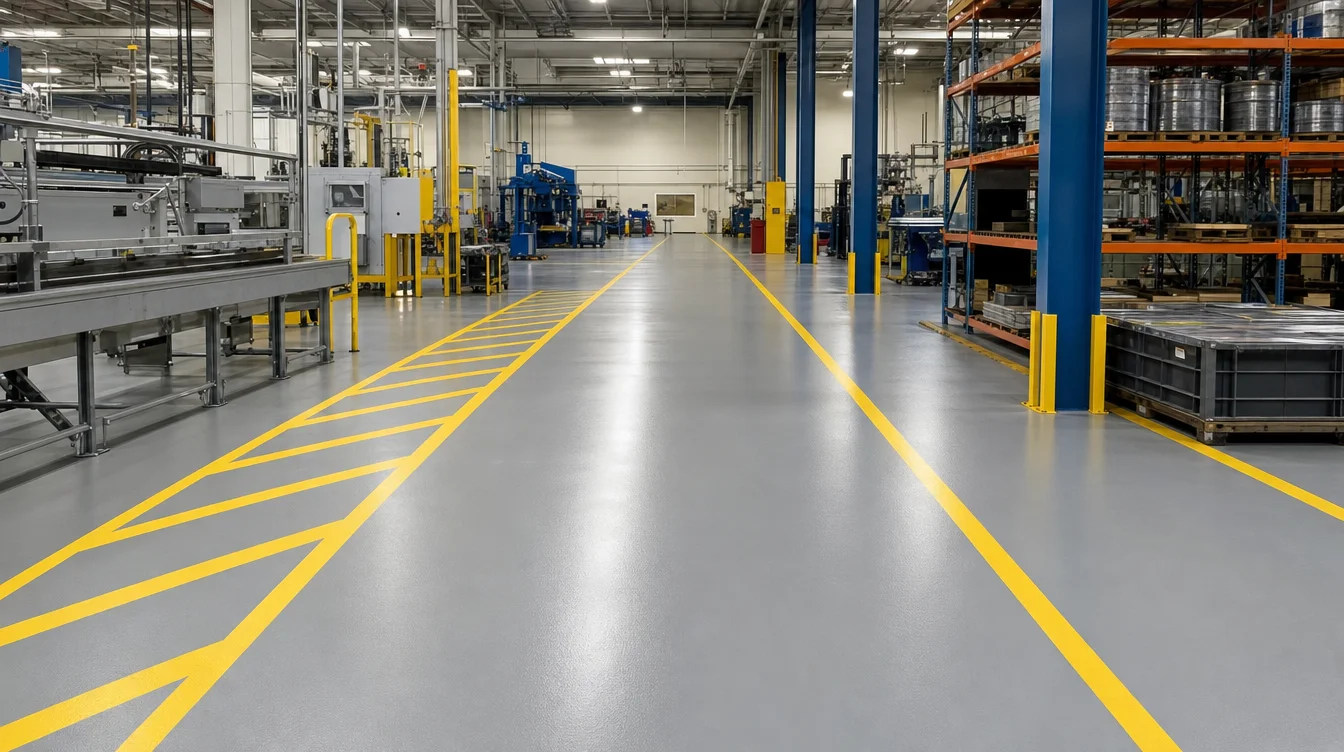
Commercial epoxy flooring for Nashville manufacturing plants has to satisfy a demanding set of requirements simultaneously: constant forklift traffic, exposure to whatever process chemicals the operation uses, and continuous or near-continuous operation that leaves little room for a lengthy shutdown. From the automotive supplier network around Smyrna to distribution and light manufacturing facilities across Rutherford and Davidson counties, here's what a properly specified manufacturing floor actually requires.
Getting the specification wrong on a manufacturing floor is far more costly than on a residential or even standard commercial project. A garage floor that under-performs is an inconvenience; a manufacturing floor that fails under forklift traffic can mean unplanned production stoppages, safety hazards from cracked or spalling concrete, and the expense of redoing work that should have been specified correctly the first time. That's why manufacturing flooring projects start with a facility assessment rather than a standard quote template.
Manufacturing Floor Demands in Nashville
A manufacturing floor sees a combination of stresses that most other commercial floors never encounter at the same intensity. Understanding these demands up front is what separates a floor that lasts for years from one that needs premature repair:
- Continuous forklift and pallet jack traffic - heavier and more constant than typical commercial foot traffic
- Process chemical exposure - specific to whatever the facility manufactures, from oils to solvents to industrial cleaning agents
- Impact resistance - dropped tools, dropped parts, and equipment movement all stress the floor surface
- Minimal downtime tolerance - most plants can't afford an extended production halt for flooring work
Bare or aging concrete under these conditions doesn't just look worn - it actively creates operational problems. Dusting concrete contaminates products and equipment, cracks widen under forklift loading, and an uneven or spalling surface becomes a genuine safety hazard for both foot traffic and material handling equipment. A properly specified epoxy system addresses all of these at once, which is why it's the standard flooring choice across Nashville's manufacturing sector rather than a premium upgrade.
Forklift-Rated Film Thickness Explained
Film thickness - how thick the cured epoxy layer actually is - matters more in manufacturing than almost any other commercial application. A standard commercial epoxy system might be specified at a lighter film build, adequate for office or retail foot traffic. Manufacturing floors under constant forklift wheel loading need a significantly heavier dry film thickness to resist the compression and abrasion that wheeled equipment creates over years of continuous use.
Under-specifying film thickness is one of the most common - and most expensive - mistakes we see on manufacturing floors that were coated by a contractor without industrial experience. A floor that looks fine on day one can show wheel-track wear within a year or two if it wasn't built to the thickness the actual traffic demands.
Film thickness also has to be balanced against a facility's specific forklift fleet and load weights. A plant running electric pallet jacks on rubber wheels puts different stress on a floor than one running propane forklifts with harder polyurethane wheels carrying heavier loads. Part of a proper industrial assessment includes understanding exactly what equipment moves across the floor daily, not just estimating traffic volume in general terms.
Chemical Resistance for Manufacturing Environments
Unlike a garage or retail floor, a manufacturing floor's chemical resistance requirements are specific to the facility's actual process. Machine shops deal with cutting oils and coolants. Automotive suppliers deal with different fluids entirely. Food and beverage processing plants need sanitation-grade resistance to cleaning chemicals used in washdown cycles. There's no single "industrial epoxy" that handles every scenario equally well - the resin chemistry has to be matched to what the plant actually exposes the floor to.
Start with a chemical inventory: Before specifying any manufacturing floor system, we ask what chemicals, oils, or cleaning agents the facility regularly uses. That inventory drives the resin selection far more than square footage or traffic volume alone, and it's a step worth insisting on from any contractor bidding on industrial work.
For facilities near Nashville's automotive manufacturing corridor, our related guide on Smyrna industrial epoxy flooring covers the specific requirements common to Tier 1 and Tier 2 supplier operations in that area. The dense concentration of automotive suppliers around the Nissan plant means many nearby facilities share similar chemical exposure profiles - machining coolants, hydraulic fluids, and cleaning solvents common to parts manufacturing - which makes it easier to specify a proven system rather than starting from scratch on every project.
Beyond the base resin chemistry, secondary considerations matter too: temperature resistance for areas near heat-generating equipment, and compatibility with any existing floor drains or trench systems that need to remain functional after the new coating goes down. These details rarely show up in a generic flooring quote but consistently come up once work actually begins on an industrial site.
Minimizing Production Downtime During Installation
Most manufacturing plants can't afford to shut down entirely for a flooring project - lost production time has a direct, quantifiable cost that makes a phased approach the standard practice for this type of work. Rather than coating the entire facility at once, installation is broken into sections or aisles, with each phase completed while the rest of the plant continues normal operation.
| Approach | Downtime Impact |
|---|---|
| Full facility shutdown | Complete production halt for the project duration |
| Phased, section-by-section install | Minimal disruption, most of the plant stays operational |
| Weekend/off-shift scheduling | Work scheduled around existing production shifts |
This kind of scheduling requires close coordination with plant management to sequence work around production needs, equipment relocation, and safety requirements - a level of project planning that goes well beyond a typical commercial flooring job. A phased project typically starts with the lowest-traffic or least production-critical section, both to establish the process and to get a real-world sense of cure time and scheduling accuracy before moving into higher-stakes areas of the plant.
Communication with plant staff matters just as much as the coating work itself. A section that's coated and curing needs clear barriers, signage, and coordination with shift supervisors so equipment and personnel don't inadvertently cross into a curing area before it's ready for traffic. On multi-week phased projects, we build a schedule with plant management up front so everyone knows which sections will be offline on which days, minimizing surprises for production planning.
Weekend and off-shift scheduling is another lever many Nashville manufacturers use to minimize disruption further. Coating during a planned weekend shutdown or between shift changes lets the floor cure through a natural downtime window rather than competing with active production hours at all. See our commercial epoxy flooring Nashville page and warehouse epoxy flooring Nashville page for more on how we scope industrial projects.