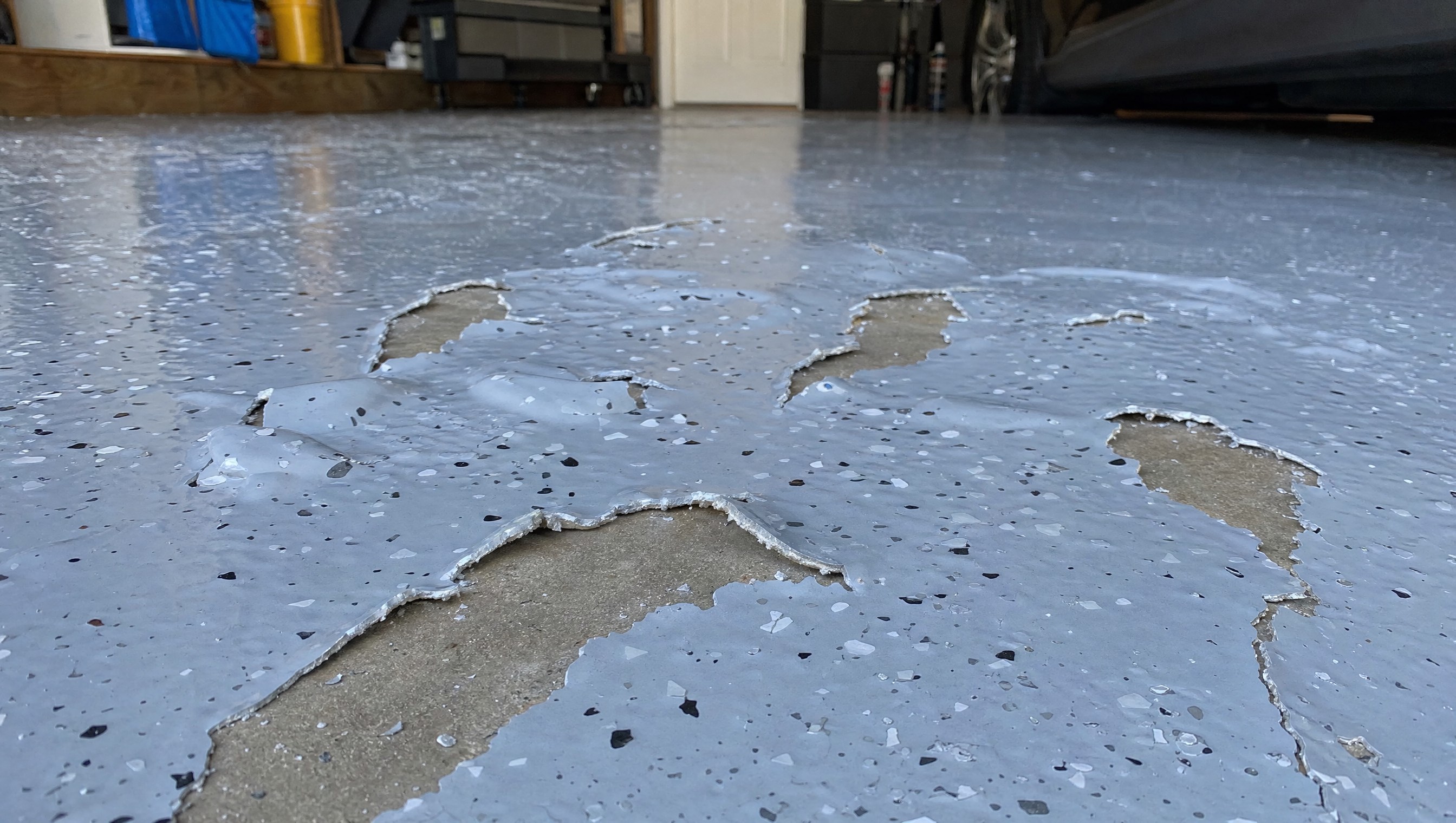
Nashville homeowners buy DIY epoxy garage floor kits at a higher-than-average failure rate compared to most U.S. cities. The kits work well in dry, mild-climate cities. In Nashville - where summer concrete surface temperatures routinely hit 100°F+ by mid-morning, humidity sits above 70% on most summer days, and garages built over Davidson County's expansive clay soil transmit moisture vapor through slabs year-round - the conditions that make epoxy fail are baked into the environment. This guide explains exactly what the kit instructions skip, and what it actually takes to get a garage floor epoxy to last in Nashville.
Why DIY Epoxy Kits Fail in Nashville More Than Most Cities
Consumer epoxy kits from home improvement stores are formulated for ideal conditions: dry concrete, 65–80°F ambient and surface temperature, low humidity. Nashville garage floors in summer present all three unfavorable factors simultaneously:
What the Kit Instructions Don't Tell Nashville Homeowners
DIY epoxy kit instructions are written for ideal conditions and leave out several items critical for Nashville success:
- No moisture vapor test requirement - kits ship no test equipment and instruct you to "check that concrete is dry." Nashville slabs with active MVT above spec look dry on the surface while transmitting moisture that will delaminate the coating
- No concrete surface profile guidance - kit instructions say "clean and etch" the concrete. Acid etch alone on dense Nashville concrete leaves a CSP-1 profile - inadequate for epoxy adhesion. Professional installation requires CSP-2 (light diamond grind) minimum
- No temperature window guidance for Nashville summers - instructions state "apply between 50°F–90°F ambient" but do not mention that direct-sun Nashville concrete can be 20–30°F above ambient in summer, pushing the slab well above the working range by 10 AM
- No degreasing protocol for oil-contaminated slabs - Nashville garages used for vehicle maintenance have motor oil, transmission fluid, or tire shine product penetrated into the concrete. Acid etch does not remove oil - it must be removed with a degreaser and grinding before epoxy adhesion is possible
- No crack repair guidance - Nashville slabs over expansive clay soils frequently develop map cracking and shrinkage cracks. Consumer kits do not address crack filling; unfilled cracks telegraph through the coating and eventually widen under the film
Nashville timing rule: If you proceed with a DIY kit despite these risks, apply in October–November or March–April when Nashville morning garage temperatures are in the 55–75°F range. Never apply during Nashville's June–August heat. Application must start before 8 AM if you attempt it in late spring or early fall.
How to Test Your Nashville Slab for Moisture Vapor
Before any epoxy application - DIY or professional - your Nashville slab must be tested for moisture vapor transmission. Two standard methods:
- Plastic sheet test (ASTM D4263) - tape a 24"×24" plastic sheet to the concrete, seal all edges with duct tape, leave 72 hours. Condensation under the plastic indicates active MVT. This is a pass/fail qualitative test only.
- Calcium chloride test (ASTM F1869) - place calcium chloride in a sealed dome on the concrete, weigh before and after 60–72 hours. Results in lbs/1,000 sqft/24 hours. Most epoxy systems require results below 3.0 lbs. Nashville slabs frequently test at 4–8 lbs without a moisture vapor barrier.
If your slab tests above 3.0 lbs/24 hrs, a moisture vapor barrier coat must be applied before any decorative epoxy. Consumer kits do not include moisture vapor barrier coats - this must be sourced separately.
DIY vs Professional Epoxy: Nashville Cost and Outcome Comparison
| Factor | DIY Kit | Professional Installation |
|---|---|---|
| Material cost (2-car garage) | $150–400 | $1,800–3,500 installed |
| Surface prep | Acid etch only | Diamond grind (CSP-2+) |
| Epoxy solids content | 40–60% (water/solvent based) | 100% solids |
| Dry film thickness | 2–4 mils | 10–20 mils |
| Moisture vapor barrier | Not included | Included when needed |
| Nashville climate suitability | Low - heat & MVT issues | High - professional systems handle it |
| Expected lifespan in Nashville | 1–4 years (if it bonds) | 10–20 years |
| Failed DIY removal cost | $800–2,000 extra | N/A |
The real cost of a failed DIY job: When a DIY epoxy fails in Nashville - peeling, bubbling, or delaminating - the failed coating must be mechanically removed before anything else can be applied. Removal of bonded epoxy from a 400–500 sqft two-car garage costs $800–2,000. This erases any savings from the DIY approach and adds $1,000–1,500 to the total cost versus hiring a professional from the start.
When to Call a Professional for Nashville Garage Epoxy
Given Nashville's specific conditions, professional epoxy garage floor Nashville installation makes more economic sense than in most U.S. cities. Specific situations where DIY risk is highest:
- Slabs over 10 years old - older Nashville slabs have more oil contamination, more surface variation, and typically tested-higher MVT than newer construction
- Any previous coating - if there's existing paint, sealer, or a prior epoxy coat, it must be fully removed before recoating; professional diamond grinding is the only reliable method
- Any visible cracks - cosmetic hairline cracks can be filled, but cracks wider than 1/8" in Nashville clay-soil slabs often indicate ongoing movement that requires assessment before coating
- Summer application deadline - if you need the floor done before fall, professional crews have the equipment to start at 6 AM and complete application before Nashville heat makes conditions unsuitable
- Attached garage adjacent to living space - professional 100% solids systems have negligible odor after cure; DIY water-based kits off-gas VOCs into adjacent living areas during and after application
Nashville Epoxy Garage Floor Cost Guide
| Option | What You Get | Total Cost |
|---|---|---|
| DIY kit (1-car, 200 sqft) | Water-based epoxy, acid etch, no MVB | $80–200 |
| DIY kit (2-car, 400–500 sqft) | Water-based epoxy, acid etch, no MVB | $150–400 |
| Pro 100% solids epoxy (2-car) | Diamond grind, MVB if needed, 100% solids, chip flake or solid | $1,800–3,500 |
| Pro polyaspartic system (2-car) | Same prep, fast-cure polyaspartic topcoat, UV stable | $2,200–4,200 |
| Failed DIY removal + pro redo | Mechanical removal + full professional installation | $2,800–5,500 |