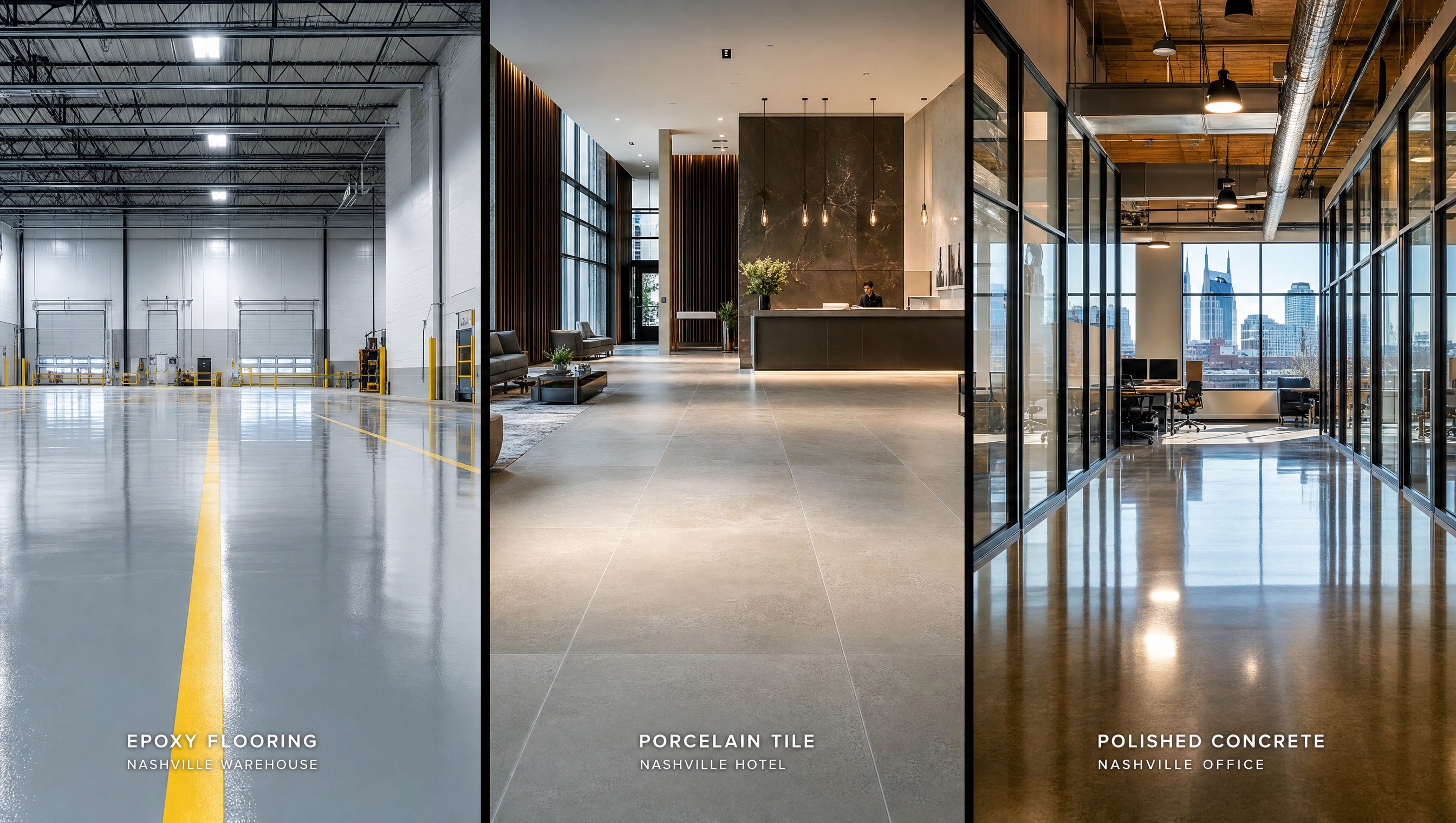
Epoxy vs Tile vs Polished Concrete: The Nashville Commercial Floor Comparison
August 31, 2026•8 min read•By Chris Leebrock
Nashville commercial property owners choosing a floor system almost always narrow it down to three options: epoxy, tile, or polished concrete. Each has a genuinely different profile of cost, durability, maintenance, and best-fit application - and the right choice depends heavily on what kind of space you're flooring. This guide gives the full side-by-side comparison so you can make an informed decision rather than defaulting to whatever a single contractor happens to sell.
The Three Main Choices for Nashville Commercial Floors in 2026
Before the detailed comparison, here's the short version: epoxy wins on chemical resistance, seamlessness, and installation speed. Polished concrete wins on longevity, sustainability, and natural aesthetics. Tile wins on absolute durability in low-chemical environments and traditional visual appeal - but carries the biggest ongoing maintenance burden of the three.
Epoxy Flooring Nashville: Pros, Cons and Best Applications
No grout lines means no bacteria harborage and no staining seams. 100% solids epoxy resists oils, chemicals, and cleaning agents better than any of the three options. Installation is fastest - typically 1–2 days for most Nashville commercial spaces.
Weaknesses
Shorter Life Than Alternatives
Epoxy's 15–20 year life span is shorter than tile or polished concrete. It also requires a topcoat recoat eventually, unlike polished concrete's zero-coating maintenance profile.
Commercial Tile Nashville: Pros, Cons and Best Applications
Commercial tile remains the traditional choice for Nashville retail and hospitality spaces where aesthetic variety and extreme surface durability matter more than chemical resistance or installation speed.
Strengths
Longevity and Scratch Resistance
Properly installed tile can last 25–50 years - the longest of the three options - with exceptional resistance to scratching and abrasion. Aesthetic variety is unmatched, with countless colors, patterns, and textures available.
Weaknesses
Grout Lines Are the Real Cost
Grout lines harbor bacteria, stain permanently, require periodic regrouting, and complicate cleaning versus a seamless surface. Installation is also the slowest of the three - 3–7 days for a typical Nashville commercial job.
Polished Concrete Nashville: Pros, Cons and Best Applications
Polished concrete Nashville has become the default choice for offices and LEED-focused developments seeking a natural, low-maintenance finish.
Strengths
Sustainability and Zero Coating Upkeep
No applied coating means no recoat cycle ever - the polished surface is the concrete itself. This also makes it a strong choice for LEED and sustainability-focused Nashville developments. Life expectancy of 20–40 years rivals tile.
Weaknesses
Limited Chemical Resistance
Without a sealant coating, polished concrete has the weakest chemical resistance of the three - unsuitable for spaces with regular oil, chemical, or acidic exposure like warehouses or food service kitchens.
Nashville Commercial Floor Comparison: Side-by-Side Cost and Performance Table
Factor
Epoxy
Commercial Tile
Polished Concrete
Initial cost
$4–7/sq ft
$6–14/sq ft
$3–8/sq ft
Life expectancy
15–20 years
25–50 years
20–40 years
Maintenance
Low
Medium (grout)
Low
Repair
Easy patch
Tile replacement
Difficult
Slip resistance
Moderate (additive)
High (textured)
Moderate
Chemical resistance
High
Medium
Low (unsealed)
Nashville install time
1–2 days
3–7 days
2–3 days
Best for
Warehouses, garages, food
Retail, hospitality
Retail, office, LEED
Which Nashville Commercial Floor System Wins by Industry?
Nashville restaurants - epoxy or urethane cement beats tile: no grout lines to harbor bacteria, superior chemical resistance to food acids and cleaning agents, and faster install minimizes closure time. See our restaurant epoxy flooring Nashville guide.
Nashville offices - polished concrete or tile both work well; epoxy is less common in corporate settings due to its more industrial aesthetic profile.
Nashville warehouses - epoxy wins decisively; tile is impractical for forklift traffic and heavy loads, and polished concrete lacks the chemical resistance warehouse operations typically require.
Bottom line: There's no universal "best" floor - the right choice depends entirely on your specific use case, chemical exposure, budget timeline, and aesthetic goals. A qualified contractor should walk through your specific space requirements before recommending a system, not just sell whichever product they specialize in.
Frequently Asked Questions
Is epoxy flooring better than tile for Nashville commercial spaces?
Epoxy beats tile for Nashville warehouses, food service, and any space requiring chemical resistance or rapid installation. Tile wins for traditional aesthetics, longevity in low-chemical environments, and extreme scratch resistance. Tile's grout maintenance is the major ongoing disadvantage.
How does polished concrete compare to epoxy for Nashville businesses?
Polished concrete offers a natural aesthetic, zero-coating maintenance, and 20-40 year life - excellent for Nashville offices and LEED projects. Epoxy offers better chemical resistance, color options, and faster installation for Nashville food service and industrial applications.
Which Nashville commercial floor is cheapest?
Initial cost ranking: polished concrete ($3-8/sq ft), epoxy ($4-7/sq ft), commercial tile ($6-14/sq ft). Over 20 years, maintenance costs shift the equation - tile grout maintenance and replacement add significantly to total cost of ownership.
Can epoxy be applied over existing tile in a Nashville commercial space?
No, existing tile must be fully removed down to bare concrete before epoxy installation. Epoxy needs to bond directly to a properly ground concrete substrate - installing over existing tile compromises adhesion and leads to early failure.
Does mixing floor systems within one Nashville commercial building make sense?
Yes, and it's common - a Nashville restaurant might use epoxy in the kitchen and back-of-house for chemical resistance while using tile in the dining room for aesthetics. A warehouse office might use polished concrete in administrative areas while the warehouse floor itself is epoxy. Matching the system to each specific room's use case usually outperforms a single blanket choice.
Get Expert Floor Recommendations
Not sure which system is right for your Nashville commercial space? We'll help you decide.