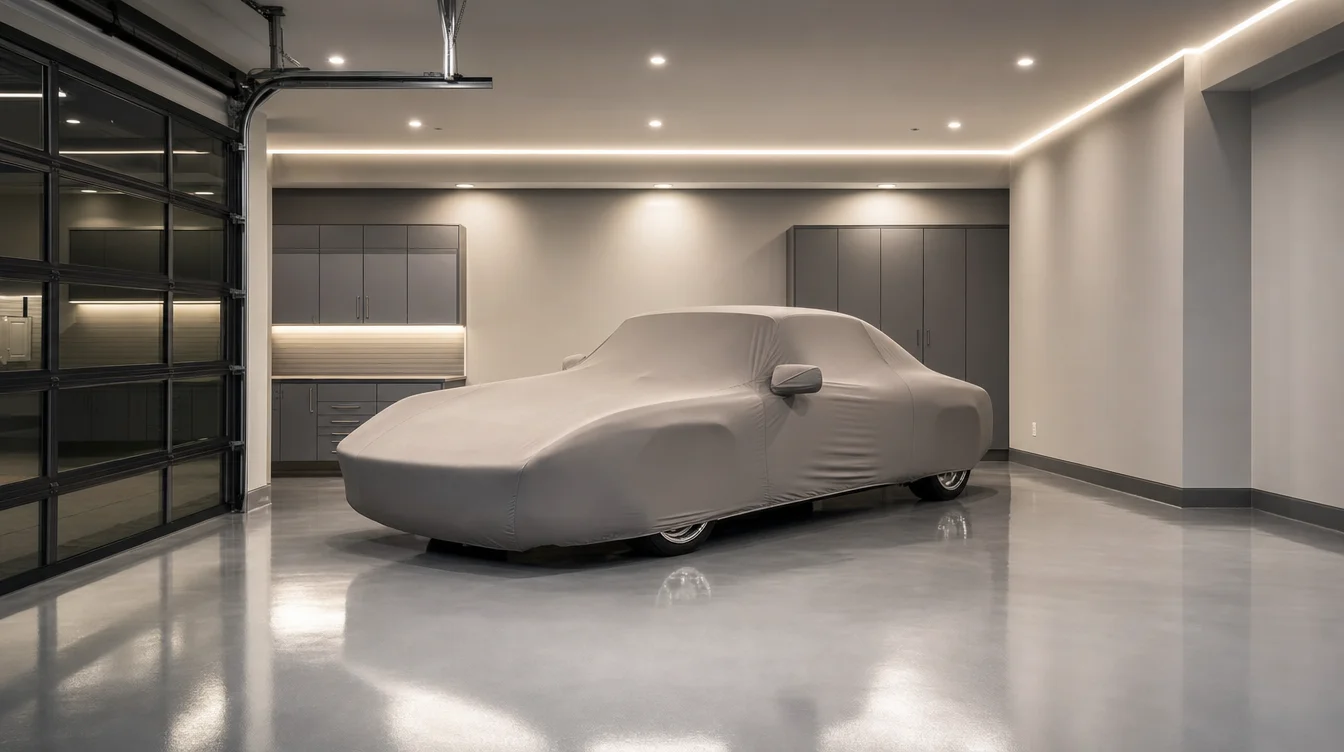
Garage flooring for Nashville classic car collectors has to do double duty: protect a genuinely valuable investment while looking good enough to serve as a display backdrop. Whether it's a numbers-matching muscle car in a Brentwood collector garage or a rotating stable of vintage imports in Williamson County, the floor underneath deserves the same level of specification as the vehicles parked on it. Here's why standard garage epoxy usually isn't enough for a serious collection, and what a properly specified collector garage floor actually involves.
Why Car Collectors Need More Than Standard Garage Epoxy
A standard residential garage floor is built for daily-driver use - dropped tools, occasional oil stains, and regular vehicle traffic. A collector garage has a different set of demands entirely. Vehicles often sit in place for extended periods rather than being driven daily, older cars are more prone to slow fluid seepage than modern daily drivers, and the garage itself frequently doubles as a showcase space where friends, potential buyers, or car club members come to see the collection.
That combination - long-term fluid exposure plus a showroom aesthetic standard - pushes collector garage specifications toward premium systems that go beyond what a typical daily-driver garage needs. The floor isn't just infrastructure; for a serious collector, it's part of how the cars are presented and protected.
We see this most clearly with Nashville clients who've built out dedicated collector spaces separate from their daily-driver garage - a converted outbuilding, a purpose-built structure, or a finished basement-level bay. In these standalone spaces, the floor gets evaluated with the same care as the vehicle selection itself, since there's no daily-use compromise pulling the specification toward a more basic system.
- Showroom-quality finish - the floor is part of the display, not just a functional surface
- Extended fluid exposure resistance - vintage vehicles often see slow leaks that a daily driver wouldn't
- UV and lighting stability - display lighting run for hours at a time shouldn't yellow the finish over time
- Long-term durability - a collection this valuable deserves a floor that won't need attention for decades
Chemical and Fluid Resistance for Classic Cars
Classic and vintage vehicles are more prone to fluid seepage than modern cars - aging gaskets, older seal materials, and carbureted fuel systems all increase the odds of small leaks accumulating over time. A collector garage floor needs to resist staining from oil, transmission fluid, brake fluid, and fuel far more reliably than a standard residential floor, since these vehicles may sit in the same spot for months between drives.
A properly specified 100% solids epoxy base coat resists all of these fluids without absorbing or staining, and because the vehicle isn't moving daily, any minor spill has time to be cleaned up before it becomes a permanent mark - provided the floor itself doesn't allow it to soak in during that window. This is one area where cutting corners on the base coat shows up years later as stubborn discoloration under a car that's barely been driven.
This is also where a thinner or lower-solids coating reveals its limits. A DIY-grade or water-based product might handle an occasional quick-wiped spill fine, but it wasn't formulated to sit under a slow drip for weeks at a time. Collectors who've dealt with a stained floor under a car that barely moves often trace the problem back to exactly this - a coating that was adequate for daily use but never intended for the long-dwell exposure a collection creates.
Long-dwell fluid exposure: A daily-driver garage sees fluids get cleaned up within hours or days. A collector garage may have the same small leak sitting in one spot for weeks - which is exactly the scenario a properly specified chemical-resistant base coat is built to handle.
Showroom-Quality Metallic and High-Gloss Finishes
Metallic epoxy has become the signature look for Nashville collector garages, and for good reason - the fluid, marbled effect reads as genuinely premium under both natural light and the track or recessed lighting many collectors install specifically to showcase their vehicles. No two metallic floors look exactly alike, which suits a space meant to feel like a personal showroom rather than a mass-produced garage.
The topcoat choice matters more here than in almost any other application. Standard epoxy without a UV-stable topcoat can gradually yellow under bright, sustained lighting - exactly the conditions a collector garage with display lighting creates every time the space is used to show off the cars. A polyaspartic or aliphatic urethane topcoat avoids that problem entirely, keeping the metallic finish looking as sharp in year ten as it did on day one.
Climate Control and Floor Coating Considerations
Many serious Nashville collectors invest in climate-controlled garage space to protect their vehicles from Nashville's humidity swings and summer heat, and that decision has implications for the floor coating too. A climate-controlled environment reduces the temperature and humidity stress on the coating itself, which can extend the practical lifespan of even a premium finish. It also protects against the kind of moisture-related issues - condensation, humidity-driven vapor transmission - that can affect an uncontrolled garage in Nashville's climate.
Even without full climate control, a moisture-barrier primer remains essential given Nashville's clay-soil moisture transmission characteristics. For collector garages specifically, we recommend moisture testing as a non-negotiable step before coating - the cost of testing is trivial compared to the cost of a coating failure under a garage full of valuable, hard-to-replace vehicles.
Lighting is another detail worth planning alongside the floor itself. Collectors often add LED strip lighting, track lighting, or accent lighting specifically to show off a vehicle's lines and the floor's finish together - and a high-gloss or metallic floor reflects that lighting in a way a matte finish simply can't. Coordinating the lighting plan with the floor finish during the design phase, rather than as an afterthought, tends to produce noticeably better results in the finished space.
| Consideration | Standard Garage | Collector Garage |
|---|---|---|
| Base coat | Standard epoxy | 100% solids, extended chemical resistance |
| Finish | Solid color or basic flake | Metallic marble, high-gloss |
| Topcoat | Standard or polyaspartic | UV-stable polyaspartic, required |
| Environment | Standard garage conditions | Often climate-controlled |
Whether you're finishing a single-bay collector space or a multi-car showcase garage in Williamson County, the specification approach stays consistent: build a floor that protects the investment as seriously as the vehicles parked on it. See our epoxy garage floor Nashville page for base system options, our metallic epoxy flooring Nashville page for finish details, and our polyaspartic floor coating Nashville page for topcoat specifics.