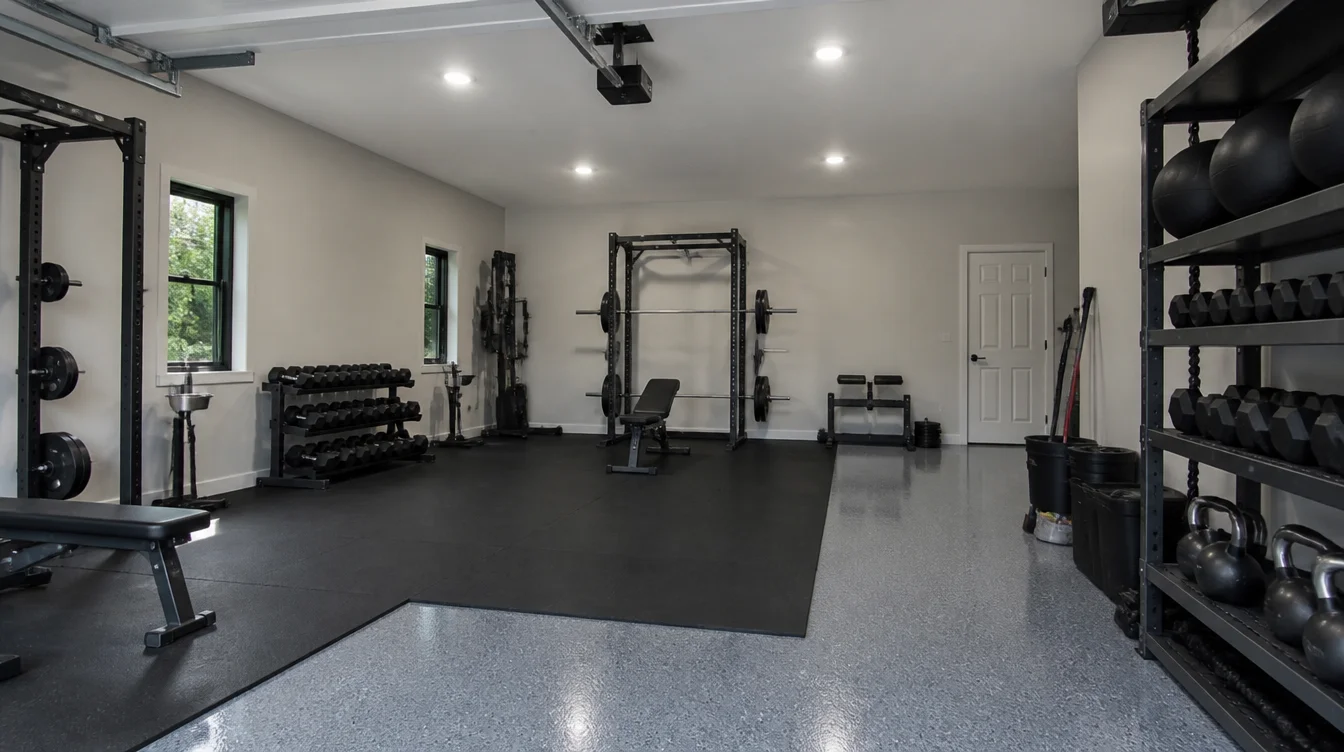
A garage home gym in Nashville is one of the most popular conversion projects we see, and the floor underneath is the detail people most often get wrong. Rolling out rubber mats over bare, unsealed concrete feels like a complete solution, but it skips a step that determines whether your gym floor stays clean and durable for years or slowly develops dust, staining, and moisture problems underneath the mats you can't see. Here's what actually belongs under your equipment.
We see this conversion happen for all kinds of reasons - a homeowner in Hermitage tired of a crowded commercial gym, a family in Mount Juliet wanting workout equipment accessible at any hour, or someone in Bellevue simply reclaiming space they weren't using for a vehicle anyway. Whatever the motivation, the floor decision made at the start of the project determines how the space holds up for years of daily training afterward, long after the initial excitement of a new home gym setup has settled into routine.
Why the Floor Matters for a Nashville Garage Gym
A home gym puts a garage floor through a different kind of stress than parking a car ever does. Dropped weights, dragged equipment, sweat, and hours of daily use in one concentrated area all add up faster than typical vehicle traffic. Bare concrete under that kind of use dusts, stains, and - critically for Nashville - continues absorbing moisture from the clay soil underneath even with mats sitting on top.
- Concrete dusting - fine particles that work their way up through mat seams over time
- Moisture transmission - Nashville's clay soil pushes moisture upward regardless of what's placed on the surface
- Sweat and spill absorption - bare concrete stains permanently where a sealed surface wipes clean
- Dropped weight impact - repeated impact on unsealed concrete gradually pits and cracks the surface
Rubber mats address the impact and comfort side of a gym floor, but they don't seal the concrete against moisture or dust - they just sit on top of whatever condition the slab is already in. That's the gap an epoxy base coat closes.
Epoxy Base Plus Rubber Mat Combinations
The best-performing Nashville garage gyms we build use a layered approach: a properly prepped and coated epoxy base across the entire floor, with rubber matting added on top specifically in weight-drop zones and areas where extra cushioning matters. This gives you a sealed, moisture-resistant, dust-free base everywhere, plus the impact absorption rubber provides exactly where it's needed most, whether that's under a squat rack, a platform for Olympic lifts, or a stretch of open floor for bodyweight and mobility work.
This combination also protects your investment in the mats themselves. Rubber matting laid directly over dusting or moisture-compromised concrete tends to trap that moisture underneath, sometimes leading to odor or mildew issues over time - a problem a sealed epoxy base underneath eliminates entirely.
Color and finish choice matter too, even in a functional space like a home gym. Many homeowners choose a solid dark color or a subtle flake blend for gym areas rather than the high-gloss metallic finishes popular in showcase garages, since a slightly more matte, utilitarian look tends to hide chalk dust and everyday wear better under intense daily use. That said, the underlying system - 100% solids epoxy with a durable topcoat - stays the same regardless of which color or finish you choose.
Moisture and Dust Control for Home Gyms
Moisture control matters more in a home gym than in a typical garage because you're spending extended time in the space, often barefoot or in athletic shoes, and any musty smell or dampness becomes immediately noticeable during a workout. Nashville's clay-heavy soil transmits moisture through concrete slabs over time, which is why moisture testing (ASTM F1869 or F2170) is a standard part of any professional installation, not an optional add-on.
Why sealing matters for daily-use spaces: A garage used occasionally for parking can tolerate some dust and moisture without anyone really noticing. A home gym used daily makes those same issues immediately obvious - which is exactly why sealing the slab properly before adding mats or equipment is worth doing right the first time.
Ventilation and airflow are worth planning alongside the floor as well, especially in a converted garage without the HVAC access a finished room would have. A well-sealed epoxy floor won't off-gas moisture the way bare concrete can, which helps keep humidity levels in the space more manageable - but it doesn't replace the need for a fan or dehumidifier in a garage gym used through Nashville's humid summer months.
Cost of Converting a Nashville Garage to a Gym
Total cost depends on square footage, the existing slab's condition, and whether you're adding rubber matting on top of the epoxy base. A single-car garage conversion costs less than a larger two- or three-car space, and a slab with existing cracks or old coatings to remove adds prep time compared to a clean, bare floor.
| Project Scope | What Affects Cost |
|---|---|
| Epoxy base coat only | Square footage, slab condition, finish choice |
| Epoxy base + rubber mat zones | Above, plus mat material and coverage area |
| Full garage-to-gym conversion | Above, plus any additional prep (crack repair, old coating removal) |
Whatever the scope, the process starts with an on-site assessment rather than a phone estimate, since slab condition varies enough between Nashville garages that an accurate quote depends on seeing the actual space. See our epoxy garage floor Nashville page for base system details, or our residential epoxy flooring Nashville page for the broader range of home applications.
Because most garage gym conversions are completed in a single day from prep through topcoat, the disruption to your household is minimal compared to the years of use you'll get out of the finished space. Many homeowners schedule the flooring work before equipment arrives, so the floor is fully cured and ready by the time racks, benches, and mats show up.
For larger, commercial-scale fitness spaces, our guide on commercial gym flooring covers the heavier-duty specification those facilities need.