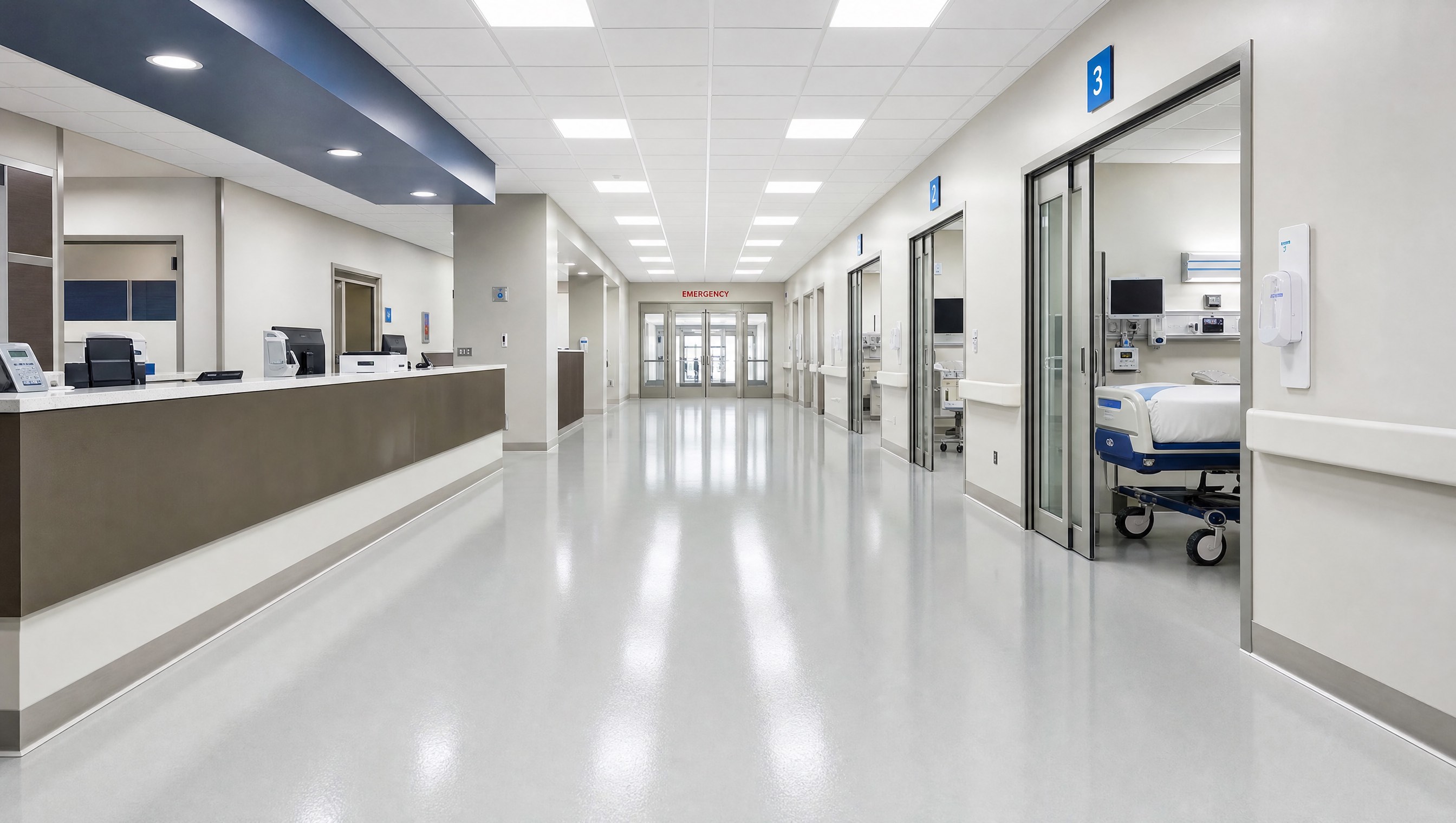
Nashville's healthcare sector - Vanderbilt University Medical Center, Saint Thomas Health, TriStar Health, and hundreds of specialty clinics and surgical centers throughout Davidson and Williamson counties - specifies epoxy flooring far beyond what standard commercial applications require. Infection control, chemical compatibility with hospital-grade disinfectants, slip resistance for wheeled equipment, and seamlessness to prevent pathogen harborage all drive floor specifications that differ significantly between a standard commercial building and a healthcare environment. This guide covers what Nashville hospitals, medical offices, and cleanrooms each require from epoxy flooring systems.
Why Healthcare Facilities Require Specialized Epoxy Flooring
Standard commercial epoxy flooring fails in healthcare environments for several specific reasons. Healthcare epoxy flooring Nashville specifications must address:
- Hospital disinfectant compatibility - quaternary ammonium compounds (quats), bleach solutions at 1:10 dilution, phenolic disinfectants, and peracetic acid all degrade standard topcoats within 6–18 months of daily use
- Seamless surfaces for infection control - grout lines, seams, and surface texture harbor bacteria and biofilm between cleaning cycles; the Joint Commission and CDC guidelines require surfaces that can be thoroughly disinfected
- Static dissipation in sensitive areas - operating rooms, MRI suites, and pharmaceutical cleanrooms require ESD or conductive floor systems to protect sensitive electronics and prevent static discharge around flammable anesthetic agents
- Slip resistance for wheeled equipment - hospital beds, IV poles, crash carts, and transport wheelchairs require a specific coefficient of friction - too smooth creates slip risk for staff; too rough creates rolling resistance that fatigues staff
- Antimicrobial properties between cleanings - antimicrobial-additive epoxy reduces surface bioburden between scheduled cleaning cycles, a significant factor in high-traffic corridors and waiting areas
Healthcare Facility Types and Their Epoxy Specifications
Nashville healthcare facilities range from large academic medical centers to small specialty clinics, and the floor specification varies substantially by area type and patient acuity:
Disinfectant Compatibility: The Specification Nashville Facilities Miss
The single most common specification failure in Nashville healthcare epoxy installations is topcoat chemical incompatibility with the facility's actual disinfection protocol. Standard epoxy topcoats are not designed for repeated exposure to hospital-grade disinfectants and degrade in predictable ways:
- Quat-based disinfectants (most common in Nashville facilities) cause surface softening and micro-crazing in standard polyaspartic topcoats within 12–18 months at clinical use frequencies
- Bleach at 1:10 dilution - the CDC-recommended concentration for MRSA and C. diff decontamination - yellows aromatic topcoats and causes adhesion failure at edges within 6–12 months
- Phenolic disinfectants (Lysol concentrate, O-phenylphenol solutions) penetrate and swell standard epoxy topcoats, causing delamination from the base coat
The correct specification for Nashville healthcare facilities is an aliphatic polyurethane or aliphatic polyaspartic topcoat that is independently tested and rated for the specific disinfectants used in that facility. The manufacturer's chemical resistance chart should be verified against your infection control department's disinfection product list - not against a generic hospital standard.
Specification tip: Request the manufacturer's chemical resistance data sheet and verify each disinfectant your EVS department uses. "Hospital grade" on a topcoat spec sheet is a marketing term, not a performance standard. The specific chemical, concentration, and exposure frequency are what determine topcoat longevity.
Cleanroom Epoxy Flooring: ISO Class Requirements
Nashville's growing biotech and pharmaceutical manufacturing sector - particularly facilities in the Tennessee Biosciences cluster - requires cleanroom-grade flooring that meets ISO classification standards. Cleanroom epoxy specifications go beyond antimicrobial requirements:
| ISO Class | Typical Use | Floor System | Key Requirement |
|---|---|---|---|
| ISO Class 8 | Compounding pharmacies, device assembly | 100% solids epoxy + aliphatic PU | Seamless, low-particle shed |
| ISO Class 7 | Sterile processing, aseptic filling | Self-leveling epoxy + cove base | ESD capable, chemical-resistant |
| ISO Class 6 | Cell therapy, vaccine manufacturing | Novolac or vinyl ester epoxy | Certified particle control |
| OR / Critical Care | Operating rooms, ICUs | Conductive epoxy system | NFPA 99, <25k ohm resistance |
Installation in Occupied Facilities: Nashville Healthcare Constraints
Nashville healthcare facilities cannot simply close for floor installations. The majority of commercial epoxy flooring Nashville healthcare projects require off-hours installation with strict constraints:
- Section-by-section phasing - large facilities install one wing or unit at a time to maintain patient care continuity
- Night and weekend shifts - installation must complete cure phases during off-hours; fast-cure polyaspartic systems return to service in 4–6 hours versus 24 hours for standard epoxy
- VOC and odor restrictions - occupied healthcare facilities require low-VOC systems because epoxy odors affect immunocompromised patients and trigger HVAC alarm protocols
- Infection control during installation - construction areas must be sealed from patient areas with ICRA (Infection Control Risk Assessment) barriers per Joint Commission standards
Fast-cure aliphatic polyaspartic systems are the standard specification for Nashville occupied healthcare installations because they minimize both cure time and VOC exposure.
Occupied facility requirement: Any contractor working in a Nashville hospital or healthcare facility must understand ICRA protocols and have experience installing in occupied healthcare environments. Standard commercial epoxy contractors without healthcare facility experience frequently create infection control compliance failures that require removal of installed work.
Healthcare Epoxy Flooring Cost in Nashville
| Facility Type | System | Cost per Sq Ft |
|---|---|---|
| Medical office / clinic | 100% solids epoxy + aliphatic PU topcoat | $6–10 |
| Hospital patient areas | Antimicrobial epoxy + disinfectant-rated topcoat | $8–14 |
| Labs & pharmacies | Novolac or vinyl ester chemical-resistant system | $10–16 |
| Operating rooms / ORs | Conductive epoxy (NFPA 99 compliant) | $12–18 |
| ISO Class 7–8 cleanrooms | Self-leveling ESD epoxy + certified topcoat | $14–22 |
Healthcare epoxy flooring costs more than commercial applications due to system complexity, lower-VOC material requirements, off-hours installation constraints, and the need for certified disinfectant compatibility. Occupied facility work (night/weekend shifts) adds 15–25% to installation cost versus standard-hours work.