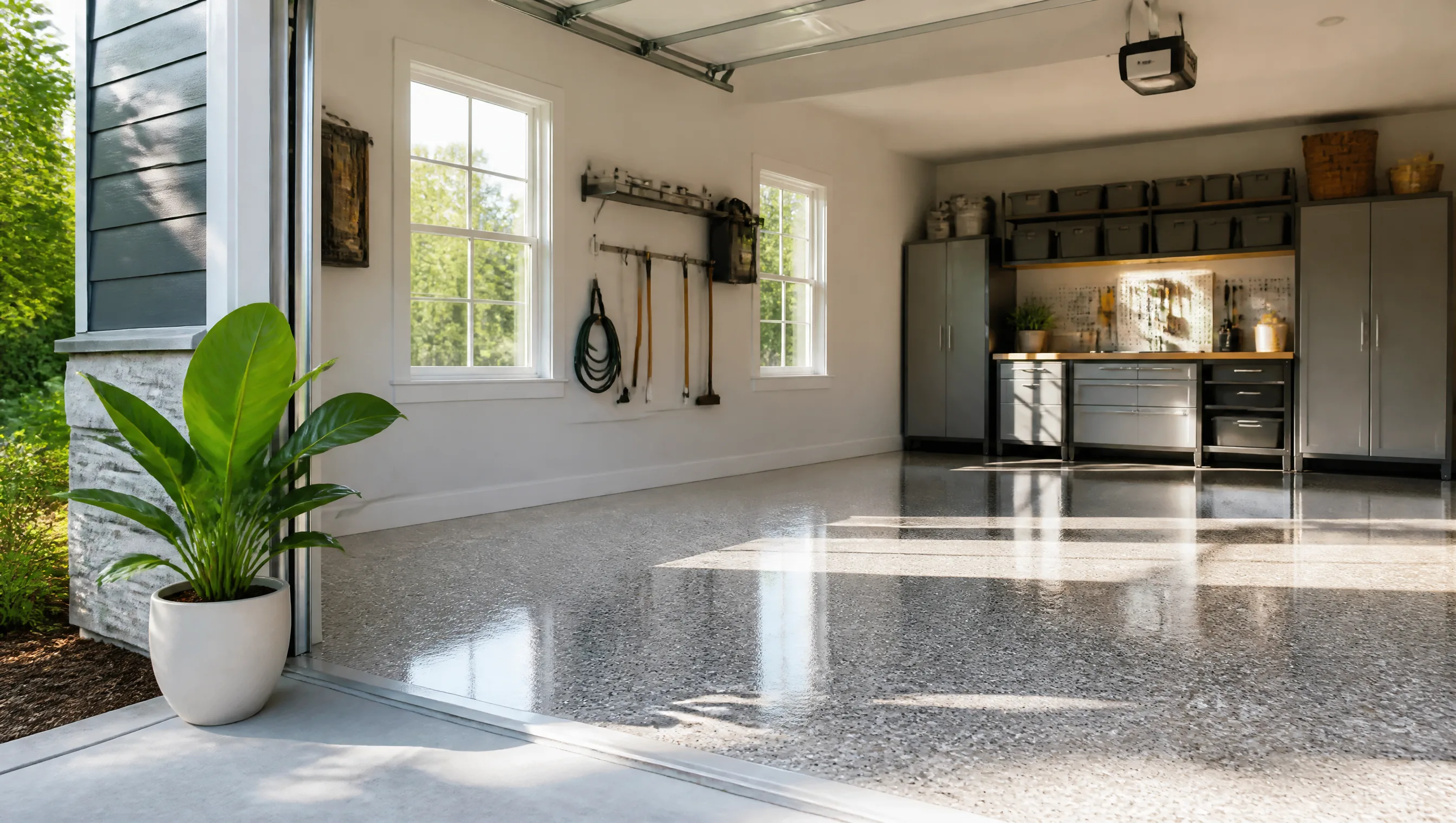
Is epoxy flooring eco-friendly? For Nashville homeowners and businesses weighing environmental impact alongside durability and cost, the honest answer is: modern epoxy is significantly more sustainable than the solvent-heavy formulas of decades past, and it compares favorably to most alternative flooring types once you factor in lifespan and maintenance.
The sustainability story isn't about epoxy being a "green" material in the way bamboo flooring markets itself — it's about low emissions during installation, an unusually long service life, and a maintenance routine that doesn't require ongoing chemical treatments. Together, those factors add up to a meaningfully smaller environmental footprint than many people assume.
What Makes a Floor Coating Eco-Friendly
When evaluating any flooring material for environmental impact, a few factors matter more than marketing language: how much volatile organic compound (VOC) emission occurs during and after installation, how long the material lasts before needing replacement, and whether ongoing maintenance requires additional chemical products.
Epoxy flooring performs well across all three when the right formulation is chosen, which is why it's increasingly specified not just for durability but as part of broader sustainability goals in both residential and commercial Nashville projects.
Low-VOC and 100% Solids Epoxy Explained
The biggest sustainability advancement in epoxy chemistry has been the shift toward 100% solids formulations. Older solvent-based epoxies relied on evaporating carriers that released significant VOCs into the air during and after application — the strong chemical smell associated with older epoxy installations. 100% solids epoxy contains no such evaporating solvents, so nearly all of the material cures directly into the finished floor.
- Near-zero VOC emissions during application and cure, a major air quality improvement over older formulas
- No lingering chemical odor in the days and weeks following installation
- Safer for occupied spaces like homes, schools, and medical facilities where air quality matters during and shortly after installation
This shift matters enough that low-VOC, 100% solids epoxy has become the standard specification for any Nashville project where indoor air quality is a real concern, not just an optional upgrade.
Ask specifically: Not every epoxy product marketed today is 100% solids. Confirm with your contractor that the specific system being quoted is a 100% solids, low-VOC formulation if sustainability and air quality are priorities for your project.
Longevity as a Sustainability Factor
One of the most overlooked sustainability factors in flooring is simply how long the material lasts before it needs to be torn out and replaced. A properly installed epoxy floor typically lasts 15 to 20 years or longer with routine maintenance, compared to carpet or vinyl flooring that often needs replacement every 5 to 10 years.
| Flooring Type | Typical Lifespan | Replacement Cycles Over 20 Years |
|---|---|---|
| Epoxy Coating | 15-20+ years | 1 |
| Carpet | 5-10 years | 2-4 |
| Vinyl/VCT Tile | 10-15 years | 1-2 |
| Standard Concrete Sealer | 3-5 years | 4-6 |
Fewer replacement cycles means less material manufactured, shipped, installed, and eventually landfilled over the life of a building. For a full look at how epoxy holds up over time, see our guide to how long epoxy flooring lasts in Nashville.
Epoxy vs Replacing Flooring Every Few Years
Beyond the material lifespan itself, epoxy eliminates several sources of ongoing chemical use that other flooring types require. Unlike waxed VCT tile or sealed concrete, epoxy doesn't need periodic wax stripping, re-sealing, or chemical refinishing to maintain its appearance — a simple neutral-pH cleaning routine is sufficient for the life of the floor.
Carpet in particular carries a heavier environmental cost profile than people often realize: manufacturing emissions, adhesive off-gassing during installation, and the fact that most carpet ultimately ends up in a landfill since it's difficult to recycle. A one-time epoxy installation that lasts 15-20 years avoids that entire replacement cycle multiple times over compared to carpet in the same space.
For homeowners and facility managers weighing the upfront cost of epoxy against the environmental and financial cost of replacing lower-durability flooring every few years, the sustainability case tends to strengthen the longer you look at the full lifecycle rather than just the install day. See our roundup of benefits of epoxy flooring Nashville properties actually get for the fuller picture beyond sustainability alone.
See our epoxy flooring Nashville page for our full range of low-VOC, 100% solids coating systems, and our concrete polishing Nashville page if you're comparing epoxy against a coating-free polished concrete option, which carries its own sustainability profile worth considering.
Installation Impact and Indoor Air Quality
Beyond the finished product, the installation process itself matters for sustainability, particularly for occupied residential spaces. With a 100% solids, low-VOC epoxy system, the strong chemical smell that older installations were known for is largely absent, and most homeowners can safely re-enter and use adjacent rooms within hours rather than days.
This matters most for households with young children, pets, or family members with respiratory sensitivities, where minimizing off-gassing during a home renovation project is a real practical concern, not just an environmental preference. Nashville's older solvent-based epoxy jobs from years past sometimes required homeowners to vacate the area for a day or more; a modern low-VOC installation rarely requires that level of disruption.
Ventilation during application still matters as standard practice regardless of formulation, but the actual chemical exposure risk with today's 100% solids systems is a fraction of what it was with older solvent-carried epoxy products still occasionally found in budget DIY kits.
How Epoxy Compares to Other "Green" Flooring Claims
Many flooring materials marketed as eco-friendly carry tradeoffs that aren't always disclosed upfront. Bamboo flooring, for example, is a rapidly renewable material, but the adhesives used in manufacturing and installation can introduce their own VOC concerns, and bamboo floors typically need refinishing every several years — undermining some of the longevity advantage that makes epoxy compelling.
Reclaimed or recycled-content flooring options sound appealing on paper, but availability, cost, and consistency can be limiting factors for a Nashville homeowner or business trying to complete a project on a normal timeline. Epoxy's sustainability case doesn't rest on using a "renewable" or "recycled" raw material — it rests on the combination of low emissions during installation and an unusually long service life that reduces the total environmental cost per year of use.
The honest framing: Epoxy isn't marketed as a "natural" material, but its low-VOC chemistry and multi-decade lifespan often outperform materials with greener-sounding marketing once you calculate total environmental impact per year of actual use.
Sustainability Considerations for Commercial Nashville Projects
Businesses pursuing LEED certification or other sustainability credentials increasingly ask about flooring VOC content and lifecycle impact during the specification process. Low-VOC, 100% solids epoxy systems can contribute toward indoor air quality credits in green building certification frameworks, making it a practical choice for commercial projects with formal sustainability goals, not just a nice-to-have for environmentally conscious homeowners.
Facility managers overseeing warehouses, retail spaces, or office buildings across Nashville also benefit from epoxy's long replacement cycle from a pure resource-planning perspective — fewer flooring replacement projects over a building's lifetime means less disruption to operations and a smaller cumulative footprint from repeated renovation work.
Documentation matters here too. Ask your contractor for the technical data sheet and safety data sheet for the specific epoxy product being used on your project, since these documents list VOC content and other environmental attributes your sustainability team or LEED consultant may need on file. A reputable Nashville epoxy contractor should be able to provide this documentation without hesitation, and its absence is worth treating as a caution flag during the bidding process.