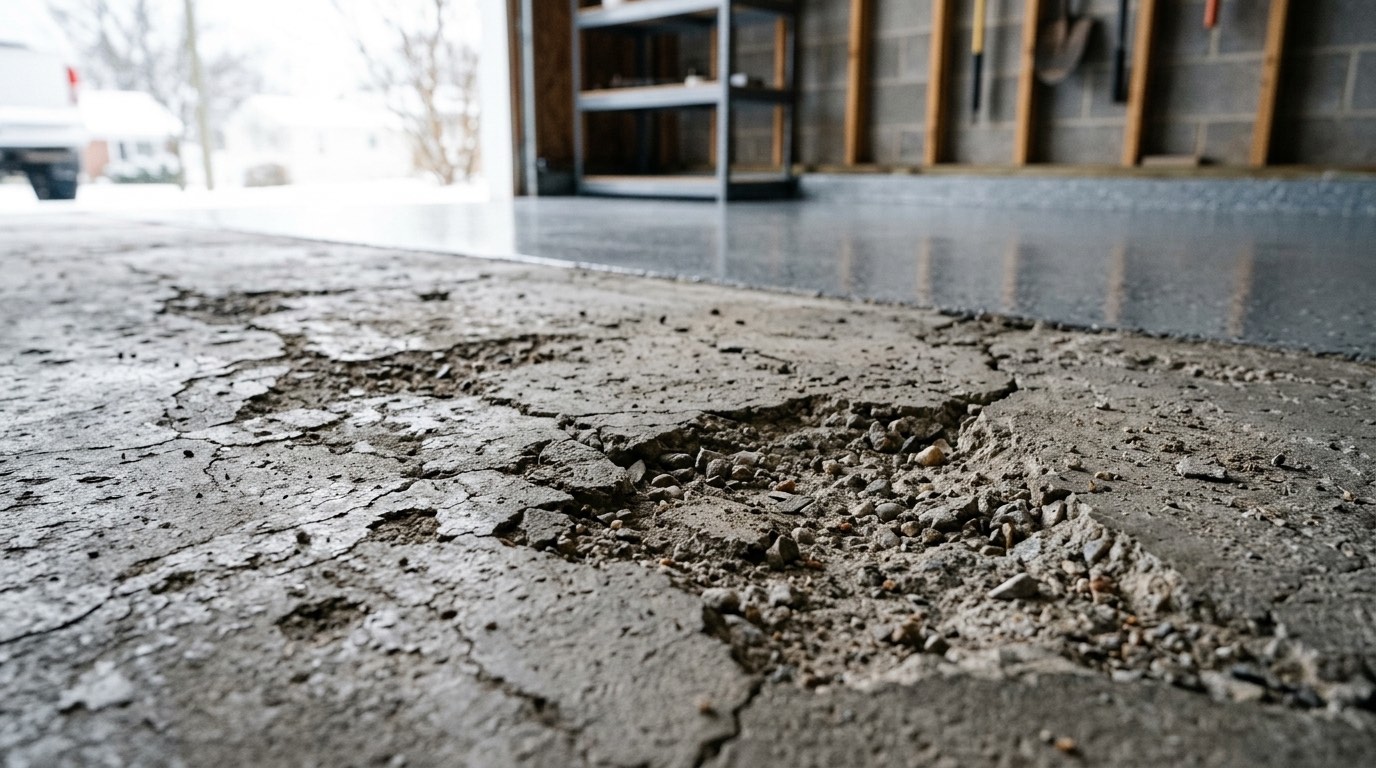
Nashville isn't Minnesota. But it's not Atlanta either. Middle Tennessee sits in a climate zone where winter temperatures regularly dance on both sides of 32°F - the exact condition that does the most damage to unprotected concrete. If you've noticed your garage floor developing cracks, surface flaking, or pitting that wasn't there a few years ago, Nashville's freeze-thaw cycles are almost certainly the cause. Here's what's happening beneath the surface, and how a sealed coating stops the damage cycle before it goes further.
Does Nashville Have Freeze-Thaw Cycles That Damage Concrete?
Yes - significantly so. Nashville averages 20–30 freeze days per year, with January and February temperatures regularly fluctuating above and below 32°F within the same week. This pattern is actually more damaging than a consistently frozen climate: sustained cold keeps water frozen; it's the cycling that causes expansion and contraction stress.
Nashville climate data: Average January lows reach 28°F, while daytime highs often climb back above freezing. This means concrete slabs can go through multiple freeze-thaw cycles in a single week during peak winter - each cycle slightly widening existing micro-cracks.
Nashville's clay-heavy soil compounds the problem. Clay has poor drainage, retaining moisture against the underside of concrete slabs far longer than sandy or gravel-based soils. That trapped moisture finds its way into the slab itself through normal concrete porosity, where it freezes, expands, and causes damage.
How Freeze-Thaw Cycles Crack and Spall Nashville Concrete Floors
The physics are straightforward. Concrete is porous - water enters through micro-cracks, surface pores, and existing damage. When that water freezes, it expands by approximately 9% in volume. That expansion exerts outward pressure on the crack walls. When temperatures rise and the ice melts, the crack doesn't fully close - it remains slightly wider than before. Over dozens of cycles across multiple Nashville winters, hairline cracks become visible cracks, and visible cracks become structural damage.
Signs Your Nashville Concrete Floor Has Freeze-Thaw Damage
Most Nashville homeowners notice these warning signs before damage reaches the structural stage - which is exactly the right time to act.
Epoxy and Polyaspartic Coatings as Freeze-Thaw Protection in Nashville
The freeze-thaw damage mechanism has a simple interruption point: keep water out of the concrete. A sealed coating eliminates the pathway by which water enters the slab in the first place. No water entry means no ice expansion means no crack widening - the damage cycle stops.
| Protection Method | Water Infiltration | Salt Resistance | Nashville Durability |
|---|---|---|---|
| Unsealed concrete | None | None | 5–10 years before visible damage |
| Penetrating sealer only | Partial | Moderate | Slows damage, re-apply every 2–3 years |
| Epoxy floor coating | Excellent | Excellent | 10–15 years with polyaspartic topcoat |
| Polyaspartic floor coating | Excellent | Excellent | 15+ years; UV-stable, no yellowing |
For Nashville garages, a full epoxy system with a polyaspartic coating Nashville topcoat is the best protection combination. The epoxy base coat creates a dense, impermeable layer that prevents water penetration. The polyaspartic topcoat adds UV stability (important for Nashville garages with southern sun exposure) and chemical resistance against de-icing salts tracked in from roads.
The Best Concrete Floor Protection Strategy for Nashville's Climate
Timing matters. The best window to protect a Nashville concrete floor is late summer through early fall - after summer humidity drops but before the first freeze. Concrete coating application requires ambient temperatures above 50°F and low humidity for proper cure. Nashville's September and October typically provide ideal conditions.
If your floor already shows surface scaling or early pitting, those areas need preparation before coating. Diamond grinding removes the compromised surface layer, exposing fresh concrete with a proper mechanical profile for coating adhesion. Attempting to coat over damaged concrete without grinding results in the coating failing at the compromised interface - the same poor-adhesion failure seen with epoxy applied over improperly prepped surfaces.
De-icing salt note: Nashville road crews use chloride-based de-icers that vehicles track into garages through winter. Chlorides don't just cause surface pitting - they migrate into concrete and attack rebar. A sealed epoxy floor keeps salt on the surface where it can be swept away, never penetrating the slab.
For floors with existing damage, the process is: diamond grind to sound concrete, repair any structural cracks with polyurea, apply moisture vapor barrier primer, install epoxy base coat, finish with polyaspartic topcoat. The result is a floor that handles Nashville winters indefinitely - and looks far better than bare concrete ever did.
Nashville Winter Concrete Damage - Common Questions
Protect Your Nashville Concrete Floor Before Next Winter
The best time to seal a Nashville concrete floor against freeze-thaw damage is before it happens. If you're seeing early signs - map cracking, surface scaling, or pitting - the time to act is now, before cold weather opens those cracks further. ProEpoxy Nashville installs full epoxy garage floor Nashville systems and polyaspartic coating Nashville with proper prep, moisture barrier primer, and UV-stable topcoat as standard. If you have existing epoxy floor repair Nashville needs first, we diagnose and address those before recoating. Protect your Nashville concrete floor before the next freeze season arrives.