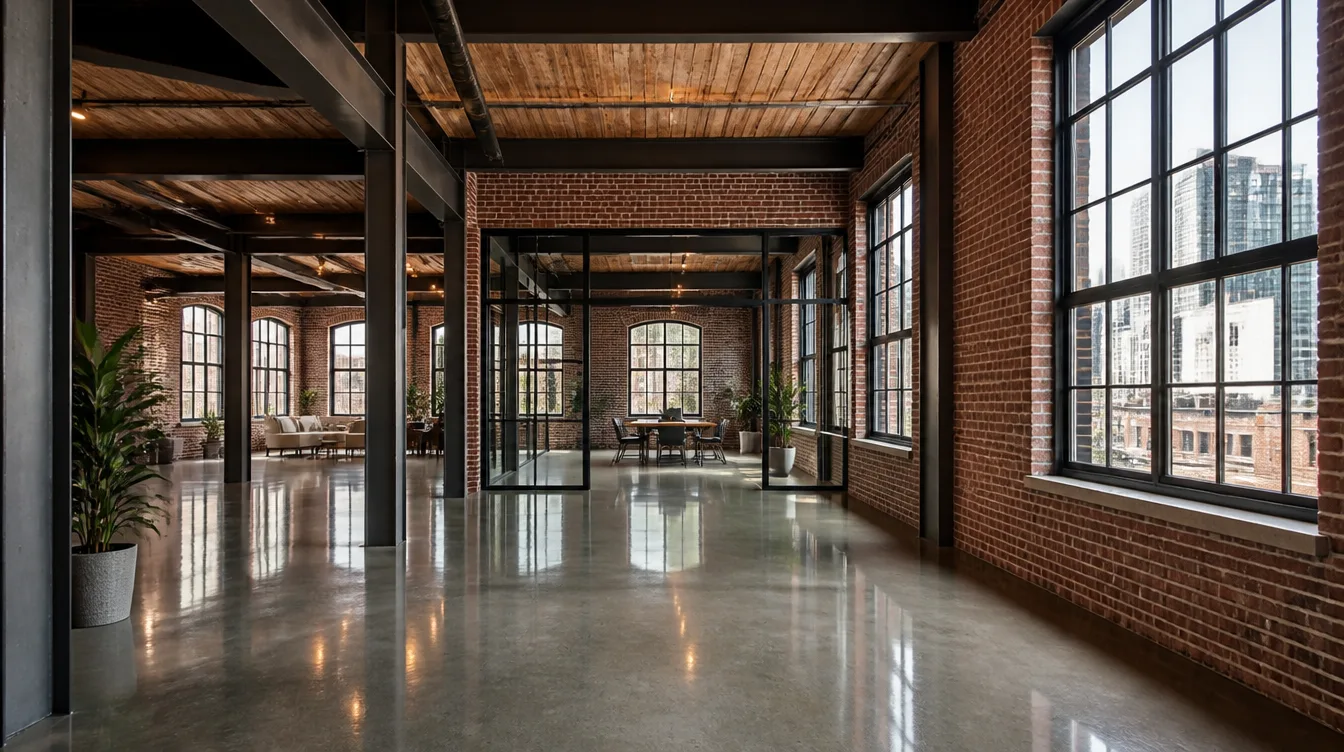
Polished concrete for Nashville's historic buildings has become the go-to flooring choice for the city's booming adaptive reuse scene, where century-old warehouses and factories are being converted into lofts, offices, and retail space. Rather than covering up the original slab with new flooring material, polishing works directly with the concrete that's already there, preserving the industrial character that makes these buildings desirable in the first place while delivering a durable, low-maintenance modern surface.
If you're renovating a historic property anywhere from Germantown to Marathon Village or the warehouse district south of downtown, understanding what polished concrete can and can't do with an aged slab will save you from surprises once the grinding equipment shows up on site.
Polished Concrete in Nashville's Adaptive Reuse Projects
Nashville's adaptive reuse boom has turned dozens of former industrial buildings into some of the city's most sought-after commercial and residential space. Marathon Village's old automobile factory buildings, Germantown's historic warehouses, and converted printing and textile facilities throughout the urban core have all found new life as loft apartments, creative offices, and boutique retail.
Polished concrete fits this trend better than almost any other flooring option because it doesn't fight the building's existing character - it enhances it. A developer converting a 1920s brick factory into modern office space wants the exposed steel beams and original masonry to stay visible, and a polished concrete floor that reflects that architecture reads as intentional rather than as a mismatch between old bones and a generic new interior finish.
This approach has also become a practical necessity as much as an aesthetic choice. Many historic commercial buildings have height restrictions or structural constraints that make a thick new flooring buildup impractical, and polishing the existing slab in place avoids adding height or load that a raised floor system would require.
Preserving Historic Character While Modernizing
One of the biggest advantages of polished concrete in a historic renovation is that the process reveals rather than replaces. Grinding through the top layer of an old slab often exposes decades of embedded aggregate, subtle color variation, and even faint markings from equipment that once sat on the floor - details a new poured floor could never replicate.
Design tip: Many Nashville architects specifically request a lower gloss level and less aggressive grinding on historic renovation projects specifically to preserve more of the original surface character rather than polishing it down to a uniform, glass-like finish.
That said, "preserving character" doesn't mean skipping proper preparation. Old coatings, adhesive residue from removed tile or carpet, and oil staining from the building's industrial past all need to be addressed before polishing begins, since grinding over contaminated concrete produces an inconsistent, patchy final result rather than the intentional aged look most owners are after.
Working With Existing Aged Concrete Slabs
Not every historic slab is a good polishing candidate without additional work, which is why a proper assessment always comes before quoting the project. An aged slab needs to be evaluated for structural cracking, moisture levels, prior coating layers, and aggregate consistency before committing to a final gloss level.
- Cracking - structural or settlement cracks need repair before grinding; cosmetic hairline cracks can often be incorporated into the finished look
- Moisture - older slabs, especially those without a vapor barrier, need moisture testing to confirm the floor won't trap moisture beneath a sealed finish
- Prior coatings - old paint, mastic, or sealer needs mechanical removal before the grinding sequence can begin
- Aggregate consistency - older slabs sometimes have inconsistent aggregate distribution, which shows up as visible variation once the surface is ground and polished
See our concrete polishing Nashville page for more on how we assess and prepare aged slabs before beginning the grinding process.
The Case for Polished Concrete in Downtown Nashville Renovations
Downtown Nashville's renovation wave - converting former office towers, warehouses, and mixed-use buildings into modern commercial and residential space - has made polished concrete one of the most requested flooring finishes among architects and developers working on these projects. It offers a combination that's hard to match with any other flooring category: low long-term maintenance cost, genuine durability under heavy foot traffic, and a look that complements rather than competes with historic architectural details.
| Consideration | Polished Concrete | New Flooring Material |
|---|---|---|
| Preserves original character | Yes, works with existing slab | Covers it entirely |
| Added floor height | Minimal to none | Often requires buildup |
| Long-term maintenance | Low - routine cleaning only | Varies, often higher |
| Upfront cost on aged slab | Moderate, prep-dependent | Moderate to high |
Beyond the flooring itself, developers working on downtown adaptive reuse projects consistently report that polished concrete simplifies the broader renovation timeline. There's no flooring material delivery to schedule around, no adhesive cure time to wait out, and no separate subfloor installation trade to coordinate - the crew works directly with the slab that's already there, which can shave real time off an overall project schedule that's often already tight against a lease-up or opening date.
The finish also ages more gracefully in high-traffic commercial settings than most alternatives. A worn hardwood or laminate floor in a busy retail space or office lobby shows scuffing and wear patterns within a few years, while a properly densified and sealed polished concrete floor can go a decade or more between maintenance touch-ups, with periodic re-burnishing rather than a full replacement being the standard upkeep cycle. For property owners thinking in terms of total cost of ownership rather than just the initial installation quote, that maintenance gap is often the deciding factor.
For property owners weighing polished concrete against other flooring categories on a renovation budget, our polished concrete cost breakdown for Nashville walks through how slab condition and gloss level affect the final price. And if your historic renovation also includes commercial or industrial space that needs a coated rather than polished finish, our comparison of polished concrete vs epoxy for Nashville warehouses covers when each option makes more sense.
Once the floor is installed, choosing the right sheen also matters for how the space reads day to day - our guide to polished concrete shine levels explained breaks down which gloss level tends to suit an office, loft, or retail buildout best.
Real-World Adaptive Reuse Considerations
A typical Marathon Village conversion involves a slab that's been through decades of industrial use - oil staining from old machinery, embedded bolt patterns from removed equipment, and sometimes multiple layers of old paint or sealer. In these cases, the prep phase often takes longer than the actual polishing, but it's what determines whether the final floor looks intentionally aged or simply patchy and inconsistent.
Office conversions in Germantown's historic warehouse district present a different challenge: these buildings are often occupied in phases, with construction happening in one section while tenants are already working in another. Dust containment and scheduling around active occupancy becomes as much a project management concern as the flooring work itself, and it's worth discussing phasing directly with your contractor before work begins rather than assuming a full building can be ground and polished all at once.
Retail buildouts in converted historic space tend to prioritize a higher gloss level than office conversions, since the reflectivity plays well with storefront lighting and helps the space feel brighter - a consideration worth walking through with sample panels under the specific lighting your unit will actually have, rather than choosing a gloss level from a photo of someone else's finished space.
Whichever gloss level and finish approach you land on, an on-site walkthrough of the actual slab remains the most reliable way to set expectations before any grinding begins - photos of another building's finished floor can't tell you how your specific slab's aggregate, staining, or crack pattern will read once it's polished.