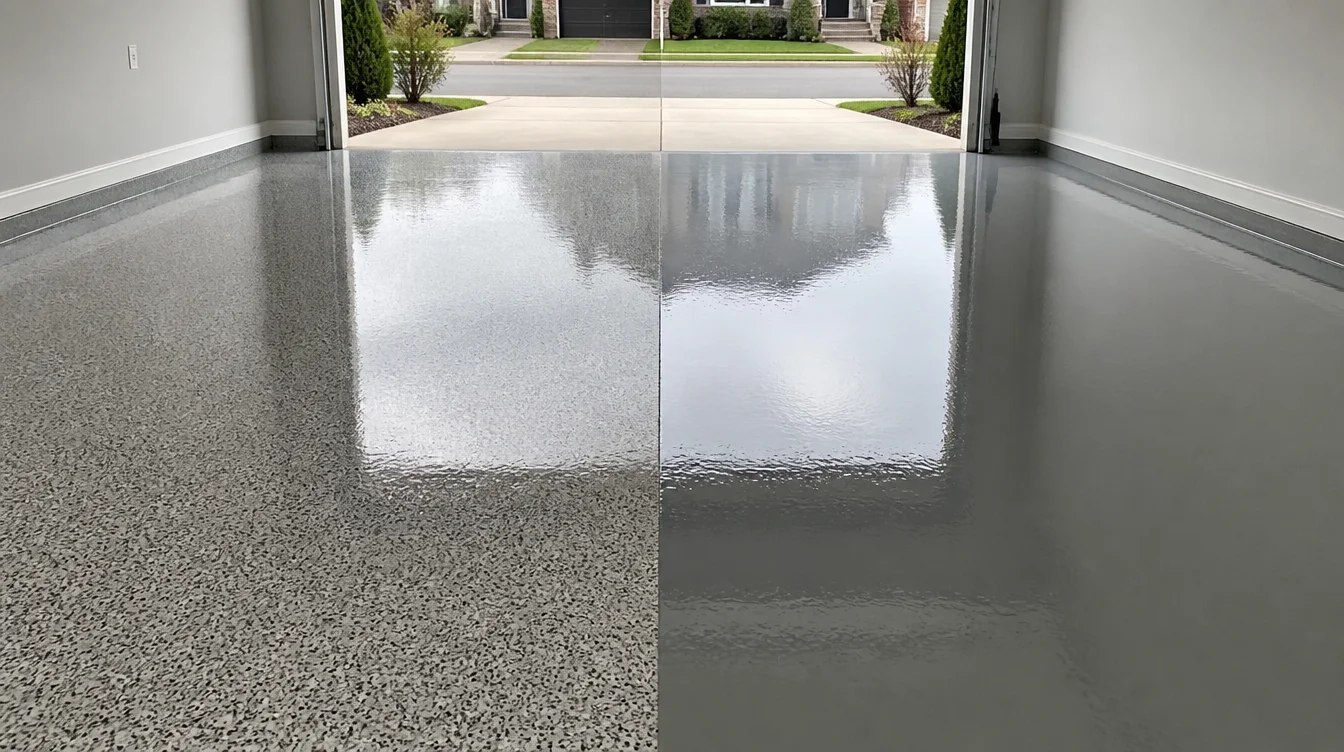
Polyaspartic vs epoxy comes down to three technical differences that actually matter for a Nashville property: cure time, UV stability, and how each performs under this region's heat and humidity. Both are legitimate floor coating chemistries - they're not competitors so much as tools suited to different parts of the same job, which is why most Nashville installations use both together rather than choosing one exclusively.
Chemistry Differences: Polyaspartic vs Epoxy
Epoxy cures through a chemical reaction between a resin and a hardener, forming a hard, durable plastic layer over hours to days. Polyaspartic is technically a type of polyurea - it cures through a different, much faster reaction mechanism, and in its aliphatic form it resists UV degradation in a way standard epoxy chemistry simply cannot.
- Epoxy - resin/hardener reaction, excellent adhesion and build thickness, but not inherently UV-stable
- Polyaspartic - polyurea-based, much faster cure, and aliphatic formulations are UV-stable
Cure Time Comparison
This is the difference property owners notice most directly. Standard epoxy typically needs 24 to 72 hours before it can handle foot traffic, and longer before full vehicle weight. Polyaspartic cures to a walkable state within hours - often the same day it's applied.
UV Stability and Yellowing Comparison
Standard epoxy is not UV stable. Floors near garage doors, windows, or skylights will gradually yellow with sustained sun exposure - a cosmetic issue, not a structural one, but a visible one over a few years. Aliphatic polyaspartic resists this yellowing, which is why it's frequently used as a UV-stable topcoat over a standard epoxy base coat rather than as a full replacement for epoxy throughout a system.
Common hybrid approach: Many Nashville installations use an epoxy base coat for cost-efficient build thickness and adhesion, topped with a polyaspartic finish coat for UV stability and fast cure. You get the strengths of both chemistries in one floor system.
Which System Wins for Nashville Climate
Nashville's summer heat and humidity favor faster-curing systems generally, since a shorter cure window means less time for ambient moisture to interfere with proper curing. Polyaspartic's rapid cure and UV stability make it a particularly strong match for Nashville conditions - especially for garages with south- or west-facing doors that see direct sun for much of the day.
| Factor | Epoxy | Polyaspartic |
|---|---|---|
| Cure time | 24-72 hours | Hours |
| UV stability | Not UV stable (yellows over time) | UV stable (aliphatic formulations) |
| Typical cost | Lower per sqft | Higher per sqft |
| Best role | Base coat / cost-effective build | Topcoat / fast-turnaround finish |
For most Nashville homeowners and property managers, the practical decision isn't really "epoxy or polyaspartic" - it's how the two are layered in your specific system. See our polyaspartic floor coating Nashville page for system options, and our related guide on polyaspartic vs epoxy Nashville climate for more on how local conditions factor into the decision.
Polyaspartic's fast cure has other practical advantages too - see our guide on polyaspartic cold weather installation for how it performs in winter conditions.