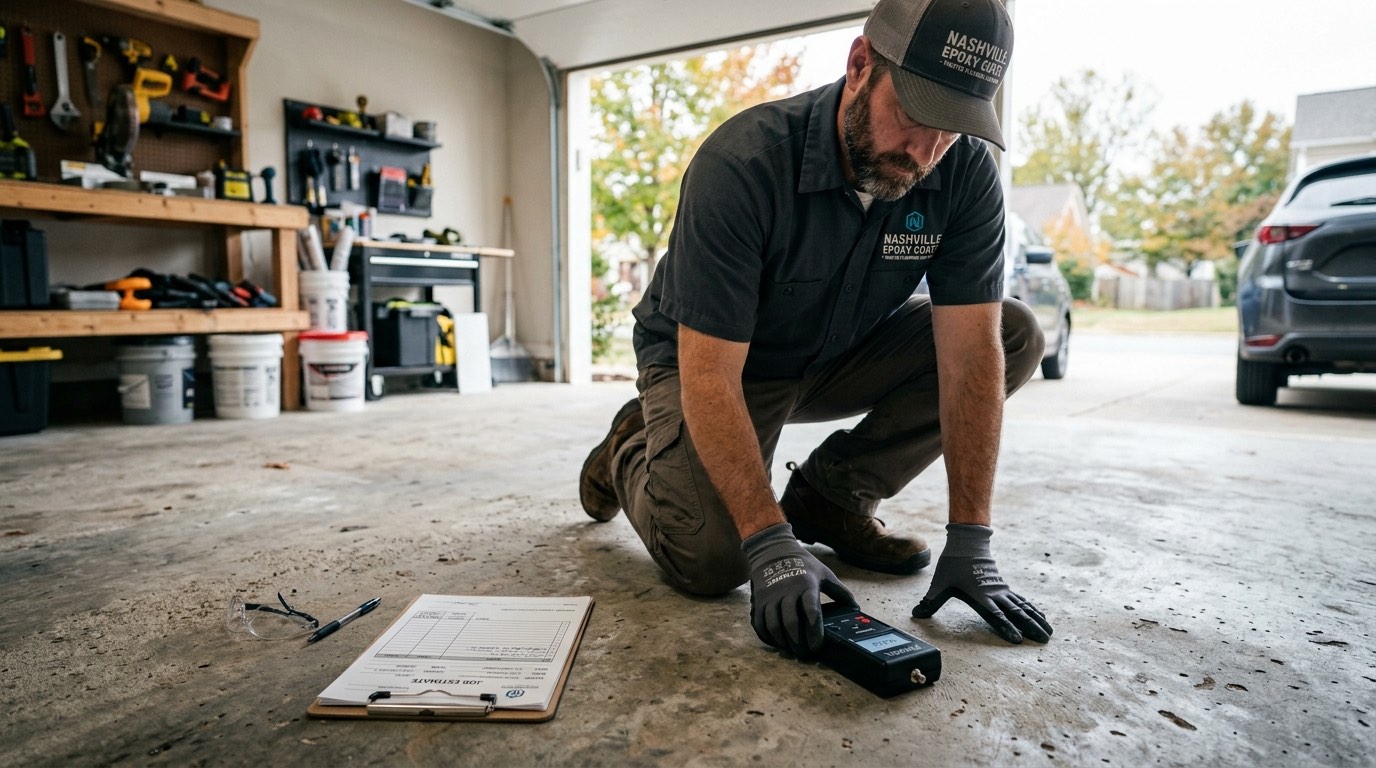
Nashville's epoxy flooring market has grown fast - and so has the number of contractors offering it. Some are excellent. Others skip critical steps to cut costs, win bids, and move on before their floors fail. The difference between a floor that lasts 15 years and one that peels in 18 months often comes down to a few specific decisions made before the first coat is applied. These 10 questions reveal exactly where corners get cut - and give you the information to tell a professional from a price-cutter before you sign anything.
Why Choosing the Right Nashville Epoxy Contractor Matters
A failed epoxy floor isn't just an aesthetic problem. Peeling, blistering, or delaminating epoxy requires full removal - diamond grinding off the failed coating, re-prepping the concrete, and starting over. That remediation costs more than the original installation would have, plus you lose use of the space during repair. The root cause of almost every Nashville epoxy failure is poor surface preparation combined with the wrong product specification - both of which are choices a contractor makes at the beginning of the job, not things that happen by accident.
The $500 cheaper quote: When one Nashville epoxy contractor quotes $1,800 and another quotes $1,300 for the same two-car garage, the $500 difference almost always comes from skipping diamond grinding (saving equipment rental) and using water-based rather than 100% solids epoxy. The $1,300 floor typically fails within 2 years. The $1,800 floor lasts a decade-plus.
The 10 Questions Every Nashville Homeowner Must Ask
Diamond grinding creates the mechanical surface profile epoxy needs to bond. Without it, adhesion depends on the concrete's surface condition alone - which is never enough for a lasting installation. Acid etching is sometimes offered as an alternative; it is not a valid substitute.
Thin coatings fail faster. Professional residential epoxy should deliver a minimum 20 mil (thousandths of an inch) dry film thickness. Commercial and industrial floors need 30+ mil. Many budget contractors apply half that, then disappear before failure.
100% solids epoxy is professional grade: no water or solvent carrier, full thickness after cure, maximum density and chemical resistance. Water-based epoxy (often marketed as "low-VOC" or "eco-friendly") shrinks significantly when the water evaporates - resulting in a thinner, weaker film. It's the product in most consumer DIY kits.
Concrete emits moisture vapor constantly. High moisture vapor emission rate (MVER) causes epoxy to blister and delaminate from below - regardless of how well the surface was prepared. Nashville's clay soil and water table mean many slabs have elevated MVER. Testing before application determines whether a moisture vapor barrier primer is needed.
A contractor confident in their prep and materials backs the work with a warranty. A contractor who skips steps doesn't - because they know the floor won't last. Warranty length and scope reveal how seriously a Nashville epoxy contractor takes their own workmanship.
Any contractor with legitimate Nashville work should be able to provide local references you can contact and photos from actual local projects. Generic stock photos and out-of-market references are warning signs for a company that lacks local history.
Oil stains, existing crack repairs, and contamination all affect epoxy adhesion differently. A professional has a protocol for each: oil stains require degreasing and potentially spot-priming; cracks require polyurea injection or epoxy mortar before coating; existing old coatings require full removal. "We grind everything" is actually a correct answer if the grinding process addresses all these issues.
A primer penetrates into the concrete pores and creates the bond layer between substrate and the epoxy system. Skipping primer saves 20–30 minutes per job and reduces material cost. It also reduces adhesion and lifespan significantly - especially in Nashville garages where moisture vapor is a factor.
Standard epoxy topcoats yellow under UV exposure - common in Nashville garages that receive afternoon sun. Polyaspartic topcoats are UV-stable, cure faster, and are significantly more abrasion and chemical resistant. A contractor using polyaspartic as their topcoat is specifying a genuinely superior system, not just using the same product throughout.
100% solids epoxy with a polyaspartic topcoat typically allows light foot traffic in 24 hours and vehicle traffic in 48–72 hours for Nashville's temperatures. Contractors who promise "drive on it tomorrow morning" for a system installed that afternoon are either using fast-cure chemistry or making promises they shouldn't keep. Either extreme - too fast or too slow - signals something is off.
Red Flags to Watch for When Hiring a Nashville Epoxy Company
Beyond the 10 questions, these signals appear in the sales process itself - before you've even asked a question.
What ProEpoxy Nashville's Answers Are to These 10 Questions
In the interest of transparency - here's how ProEpoxy Nashville answers every question on this list:
| Question | ProEpoxy Nashville Answer |
|---|---|
| Diamond grind? | Yes - every installation, no exceptions |
| Dry film thickness? | 22–28 mil full system (primer + base + topcoat) |
| 100% solids epoxy? | Yes - professional-grade product on every job |
| Moisture test? | Yes - calcium chloride test before quoting |
| Warranty? | 5 years - adhesion, peeling, delamination covered |
| Local references? | Yes - Nashville references provided on request |
| Stain/crack treatment? | Yes - degreasing, polyurea crack fill, primer |
| Primer coat? | Always - penetrating epoxy primer standard on every job |
| Polyaspartic topcoat? | Yes - UV-stable polyaspartic topcoat standard |
| Return to vehicle traffic? | 48–72 hours - communicated at scheduling based on weather |
Nashville Epoxy Contractor Questions Answered
Get ProEpoxy Nashville's Honest Estimate Today
ProEpoxy Nashville will answer every question on this list before you sign. We provide written specifications including products, prep method, system thickness, and warranty terms. Our epoxy garage floor Nashville installations include diamond grinding, 100% solids epoxy, moisture testing, primer coat, and a UV-stable polyaspartic topcoat Nashville - as standard, not as upsells. Get ProEpoxy Nashville's honest estimate - ask us any of the 10 questions above and we'll answer every one of them in writing.