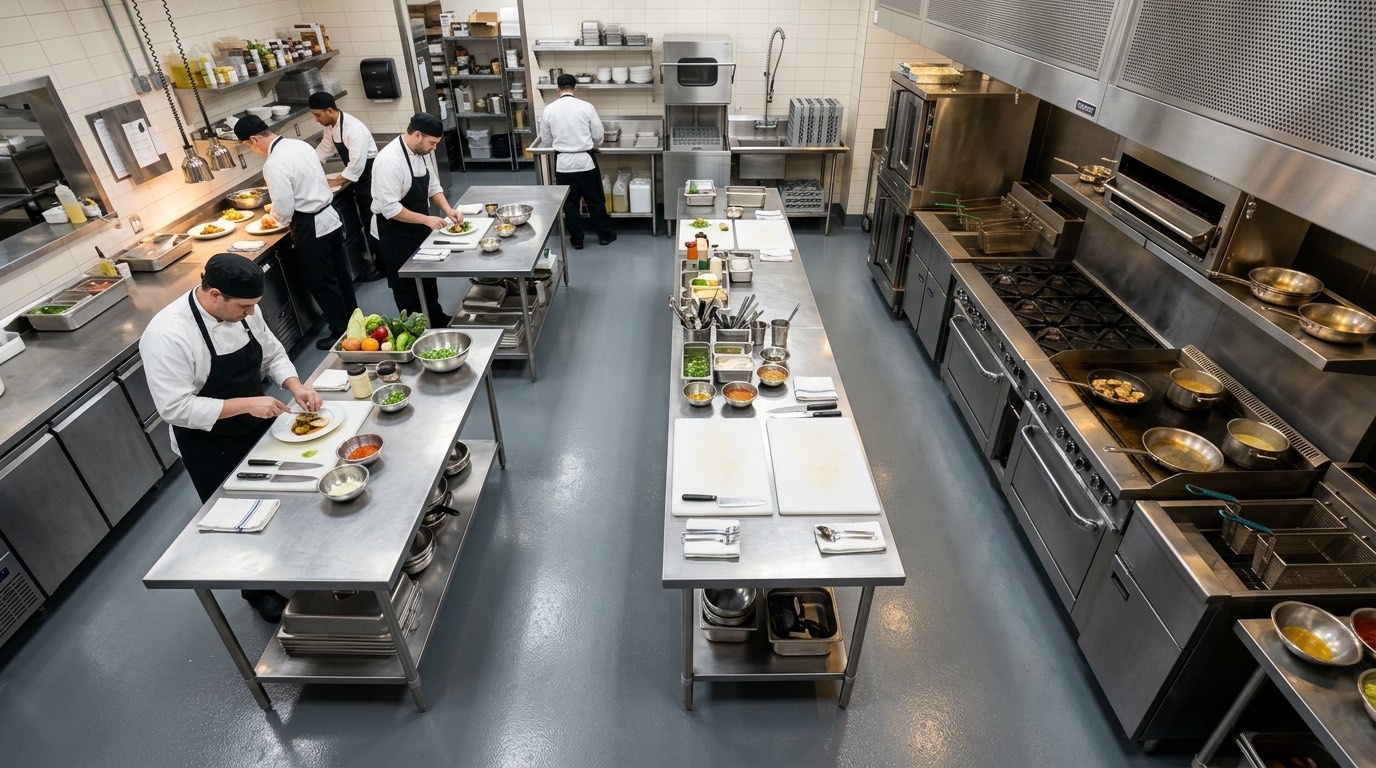
Nashville has more than 800 restaurants in the metro area - and every one of them needs floor coatings that pass Tennessee Department of Health inspection. The requirement isn't vague: kitchen floors must be smooth, non-porous, cleanable, and impervious to moisture. That means seamless systems only. Tile with grout lines fails. Unsealed concrete fails. Paint fails.
What passes: NSF 51-listed epoxy and urethane cement. Here's what Nashville restaurant owners and kitchen managers need to know before specifying or replacing their floor coating.
Why Nashville Restaurant Floors Must Meet NSF 51 Standards
NSF International Standard 51 covers materials and components that come into contact with food or food-contact surfaces. For floors, the relevant zone is within 6 inches of food preparation areas - which in most commercial kitchens means the entire cooking line, prep tables, and dish areas.
Tennessee Department of Health inspectors cite three specific floor deficiencies most often in Nashville restaurants:
- Grout lines between tiles - bacteria and grease accumulate, impossible to sanitize completely
- Exposed floor-to-wall junctions - right-angle gaps where the floor meets the wall harbor vermin and cannot be cleaned to inspector satisfaction
- Cracked, chipped, or non-seamless surfaces - any break in the coating creates a harbor for contamination
A properly installed NSF 51-listed seamless floor coating eliminates all three. The inspection risk disappears because the floor physically cannot harbor contamination in the ways that generate violations.
Approved Epoxy Systems for Nashville Commercial Kitchens
Two coating families qualify for food-service compliance in Nashville: standard epoxy and urethane cement. They are not interchangeable, and the right choice depends on what happens on your kitchen floor.
Not all epoxy products are NSF 51-listed. You must specify NSF 51-compliant products, not just any epoxy. Standard garage-grade or industrial epoxy may not be food-zone rated. Always request product data sheets confirming NSF 51 listing before approving any specification.
Urethane Cement vs Epoxy for Nashville Restaurant Floors
This is the most important decision in a commercial kitchen floor spec. Both systems pass health department inspection when properly installed - but they perform very differently under kitchen conditions.
| Factor | Urethane Cement | Standard NSF Epoxy |
|---|---|---|
| Thermal shock resistance | Excellent - survives 180°F steam cleaning | Moderate - can craze under repeated thermal shock |
| Chemical resistance | Excellent - resistant to degreasers, acids, bleach | Good - adequate for most restaurant chemicals |
| Cove base capability | Yes - integral seamless cove base | Limited - requires separate cove material |
| Slip resistance | High - aggregate options for wet zones | Good - broadcast aggregate available |
| Return to service | 4–6 hours foot traffic | 6–12 hours foot traffic |
| Cost (installed) | $8–14/sq ft | $5–9/sq ft |
| Best for | Cooking line, dish area, walk-ins | Dining room, storage, dry prep areas |
Most Nashville restaurant floor projects end up as hybrid specifications: urethane cement in the kitchen and dish area, standard NSF epoxy in dining rooms, storage, and front-of-house. This gives you compliance everywhere with cost optimization outside the high-abuse zones.
Cove Base Installation: Nashville Health Department Requirements
Cove base is the 4-inch curved transition where the floor meets the wall. Nashville health inspectors specifically look for this detail - a right-angle floor-to-wall junction is a sanitation violation because it's physically impossible to clean to the corner.
Required detail: Tennessee food service regulations require floors in food prep areas to "be smooth, durable, and easily cleanable, or nonabsorbent for areas subject to moisture." The floor-to-wall junction must be coved. Inspectors measure whether the cove is present and whether it's seamless - a bead of caulk doesn't satisfy this requirement.
Urethane cement cove base is the preferred solution. It's installed as part of the same system as the floor - the same material, mixed and troweled up the wall 4 inches with a radius form. The result is a single continuous surface with no seam between the floor and cove. This is what inspectors want to see.
Standard epoxy systems require a separately installed cove base - typically a prefabricated rubber or vinyl cove strip. While these can pass inspection when properly installed and sealed, they introduce a seam where the cove meets the floor that can fail over time. Urethane cement eliminates that seam by design.
Restaurant Epoxy Flooring Cost in Nashville: What Owners Budget
| Application Zone | System | Installed Cost |
|---|---|---|
| Cooking line / dish area | Urethane cement + cove base | $10–14/sq ft |
| Walk-in cooler / freezer floor | Urethane cement (thermal shock rated) | $9–13/sq ft |
| Dry prep / storage | NSF epoxy flake | $5–8/sq ft |
| Dining room | Decorative epoxy or polished concrete | $4–9/sq ft |
| Bar / service area | NSF epoxy with aggregate | $6–9/sq ft |
| Full restaurant (1,500–3,000 sq ft) | Hybrid spec | $7–11/sq ft avg |
Projects over 10,000 square feet typically qualify for volume pricing at 15–25% below single-unit rates. Multi-location Nashville restaurant groups running phased installs across multiple properties should ask about portfolio pricing when requesting quotes.
Nashville-Specific Installation Considerations
Nashville's Restaurant Boom and Floor Replacement Demand
Nashville's food and beverage scene has grown by over 30% in the past five years. Many of the kitchens that opened during that expansion wave used lower-cost floor solutions that are now failing - peeling tile, cracked grout, delaminating paint. The replacement cycle is accelerating. Restaurants that installed inadequate floors in 2020–2022 are now facing health inspection pressure to upgrade.
Overnight and Closed-Period Installs
ProEpoxy installs Nashville restaurant floors during overnight or closed periods - typically 10 PM to 6 AM on weeknights, or during scheduled closures. Urethane cement systems return to foot traffic in 4–6 hours, making single-night installations possible for most kitchen areas. Full chemical resistance for aggressive cleaning chemicals is achieved at 72 hours. We schedule around your covers - you lose no revenue during installation.
Tennessee Health Department Pre-Inspection
If your restaurant is undergoing a health department pre-inspection before opening or after renovation, we can provide documentation including product data sheets confirming NSF 51 listing, application records, and thickness measurements. This documentation satisfies inspector requests for specification verification on the floor system.
FAQ: Nashville Restaurant Floor Coating Questions
Get Your Nashville Restaurant Floor NSF-Compliant Today
Whether you're preparing for a health department inspection, replacing a failing kitchen floor, or specifying a new build-out, ProEpoxy Nashville can assess your floor, recommend the right system, and install during your off-hours. Call (888) 275-7078 or use our contact form for a free assessment and written quote.
We serve all Nashville restaurant types - independents, regional chains, hotel food service, event venues, and catering kitchens - with the same NSF-compliant system specification regardless of project size.