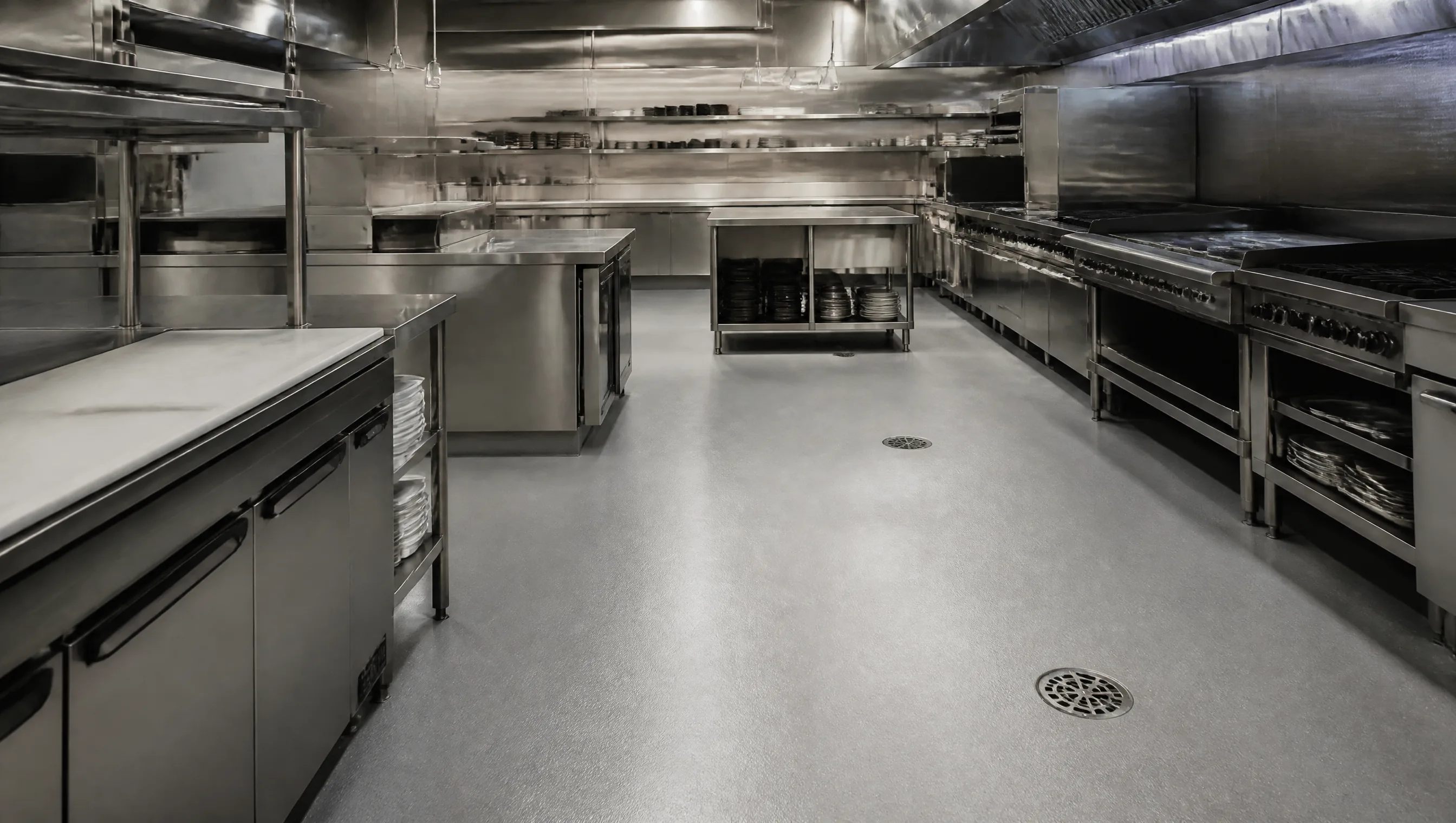
Polyaspartic floor coating for Nashville commercial kitchens has become the go-to spec for restaurant owners who can't afford a week-long shutdown to redo their kitchen floor. Where standard epoxy systems can take days to fully cure, polyaspartic coatings cure fast enough that many kitchens are back in full operation within 24 hours of the final coat going down.
That speed advantage matters enormously in a business where every closed day is lost revenue, but it's not the only reason polyaspartic has become the preferred system for kitchen floors from Hillsboro Village cafes to full-service restaurants along the Gulch. The chemistry also happens to be exceptionally well suited to what a working kitchen floor actually experiences day to day.
Why Commercial Kitchens Need Fast-Cure Flooring
A restaurant kitchen generates revenue every hour it's open, which makes flooring downtime one of the most expensive line items in any renovation or repair project. Standard epoxy systems typically require three to seven days of cure time before they can handle full commercial kitchen traffic - rolling carts, hot equipment, constant foot traffic - which usually means closing the kitchen or working around a partially usable floor for most of a week.
Polyaspartic coatings cure through a fundamentally different chemical reaction that completes in a fraction of the time. Many installations can be walked on within hours of application and returned to full service, including heavy equipment traffic, within 24 hours. For a restaurant, that's the difference between losing one night of service and losing most of a week.
- Standard epoxy: 3-7 days to full cure and heavy traffic readiness
- Polyaspartic: walkable in hours, full service within 24 hours
- Multi-coat systems: polyaspartic's fast recoat window also means multiple coats can often be applied in a single day, rather than spread across a multi-day schedule with epoxy's longer recoat windows
Chemical and Grease Resistance Comparison
Commercial kitchen floors face a uniquely punishing combination of hot grease, food acids from citrus and tomato-based products, degreasing chemicals, and near-constant hot water wash-down. Polyaspartic coatings generally hold up well against this combination, resisting the kind of softening and discoloration that can affect lower-grade coatings under sustained grease and chemical exposure.
| Exposure | Standard Epoxy | Polyaspartic |
|---|---|---|
| Hot grease | Moderate resistance | Strong resistance |
| Food acids (citrus, tomato) | Can degrade over time | Strong resistance |
| UV / fluorescent light exposure | Can yellow over time | Stays color-stable |
| Hot water wash-down | Good, with proper cure | Good, faster full cure |
The wash-down cycle deserves particular attention since it's the one exposure a kitchen floor faces every single day without exception, often multiple times per shift depending on the volume of the operation. A seamless, fully cured coating with no grout lines or seams for grease and food debris to collect in is what actually keeps a kitchen floor sanitary between deep cleanings, regardless of which specific coating chemistry is used.
NSF Compliance and Food Safety Standards
Commercial kitchens operating under health department inspection need flooring that meets recognized food safety standards, and NSF-compliant polyaspartic formulations are widely available and commonly specified for exactly this reason. An NSF-listed floor coating gives inspectors and health departments confidence that the surface meets established criteria for food contact area surfaces.
Ask your contractor directly: not every polyaspartic product on the market carries NSF certification, so confirm the specific product being specified for your kitchen is NSF-compliant if that's a requirement for your health department inspection or franchise standards.
Beyond the certification itself, the practical food-safety benefits of a properly installed seamless coating are straightforward: no grout lines to harbor bacteria, integral cove base at wall junctions to eliminate hard-to-clean corners, and a surface that withstands the repeated sanitizing chemicals health inspections expect to see in daily use across a Nashville commercial kitchen.
Minimizing Kitchen Closure Time
Beyond the coating chemistry itself, the way a project is scheduled makes a real difference in how much closure time a restaurant actually experiences. Most commercial kitchen polyaspartic jobs can be sequenced to minimize disruption significantly compared to a typical epoxy timeline.
Scheduling installation for a planned closure day - many restaurants choose a Monday or a slower midweek day - combined with polyaspartic's fast cure means most kitchens are back to full service within one to two days total, a fraction of what a traditional epoxy timeline requires.
See our polyaspartic floor coating Nashville page for the full range of polyaspartic systems we install, and our restaurant epoxy flooring Nashville page for the broader set of flooring options restaurants and commercial kitchens typically consider.
If your kitchen sits inside a larger production or brewing facility, our guide to commercial epoxy flooring for Nashville breweries and distilleries covers how taproom kitchen areas are typically specified alongside the production floor. And for a deeper look at how polyaspartic compares to standard epoxy more broadly, see our polyaspartic vs epoxy deep dive.
Slip Resistance in a Wet, Greasy Environment
A commercial kitchen floor is arguably one of the most demanding slip-resistance environments in any building type. Between constant wash-down water, grease splatter near fryers and grills, and ice or condensation near walk-in coolers, a smooth or glossy coating becomes a genuine safety hazard almost immediately.
Polyaspartic systems for kitchen floors are almost always specified with an aggressive aggregate broadcast - typically an angular silica or aluminum oxide media worked into the base coat before the topcoat is applied. This creates real mechanical texture rather than a coating that only looks slip-resistant, and it's specifically engineered to maintain grip even when the surface is wet and greasy, not just wet.
- Cook line and fryer areas: highest grease exposure, typically gets the most aggressive aggregate broadcast
- Dish pit and wash-down zones: constant standing water requires reliable wet-traction performance
- Walk-in cooler thresholds: temperature transitions can create condensation, requiring the same slip-resistant spec extended a few feet past the cooler door
- Dry storage and office areas: lower slip-resistance requirements, sometimes specified with a smoother, easier-to-clean finish
Health inspectors and insurance underwriters both pay close attention to kitchen floor slip resistance, since slip-and-fall incidents are among the most common workers' comp claims in food service. A properly specified polyaspartic system addresses both the safety requirement and the sanitation requirement in the same installation, which is part of why it's become the standard recommendation for new kitchen builds and floor replacements alike across Nashville's restaurant industry.
Cost Considerations for Kitchen Flooring Projects
Polyaspartic systems typically carry a higher material cost per square foot than standard epoxy, but the comparison looks different once lost revenue from kitchen downtime is factored in. A restaurant closing for a full week during a standard epoxy installation is losing far more in lost sales than the material cost difference between the two systems.
| Factor | Standard Epoxy | Polyaspartic |
|---|---|---|
| Material cost per sq ft | Lower | Higher |
| Typical closure time | 3-7 days | 1-2 days |
| Lost revenue during install | Higher | Lower |
| Long-term chemical resistance | Good | Very good |
For most full-service restaurants and commercial kitchens, the real comparison isn't material cost per square foot in isolation - it's total project cost including lost revenue, which is exactly why so many Nashville restaurant owners have shifted toward polyaspartic even at a higher upfront material price. Franchise operators managing multiple locations across greater Nashville tend to see this most clearly, since a single week-long closure repeated across several stores adds up to a meaningful revenue hit that a faster installation avoids almost entirely.