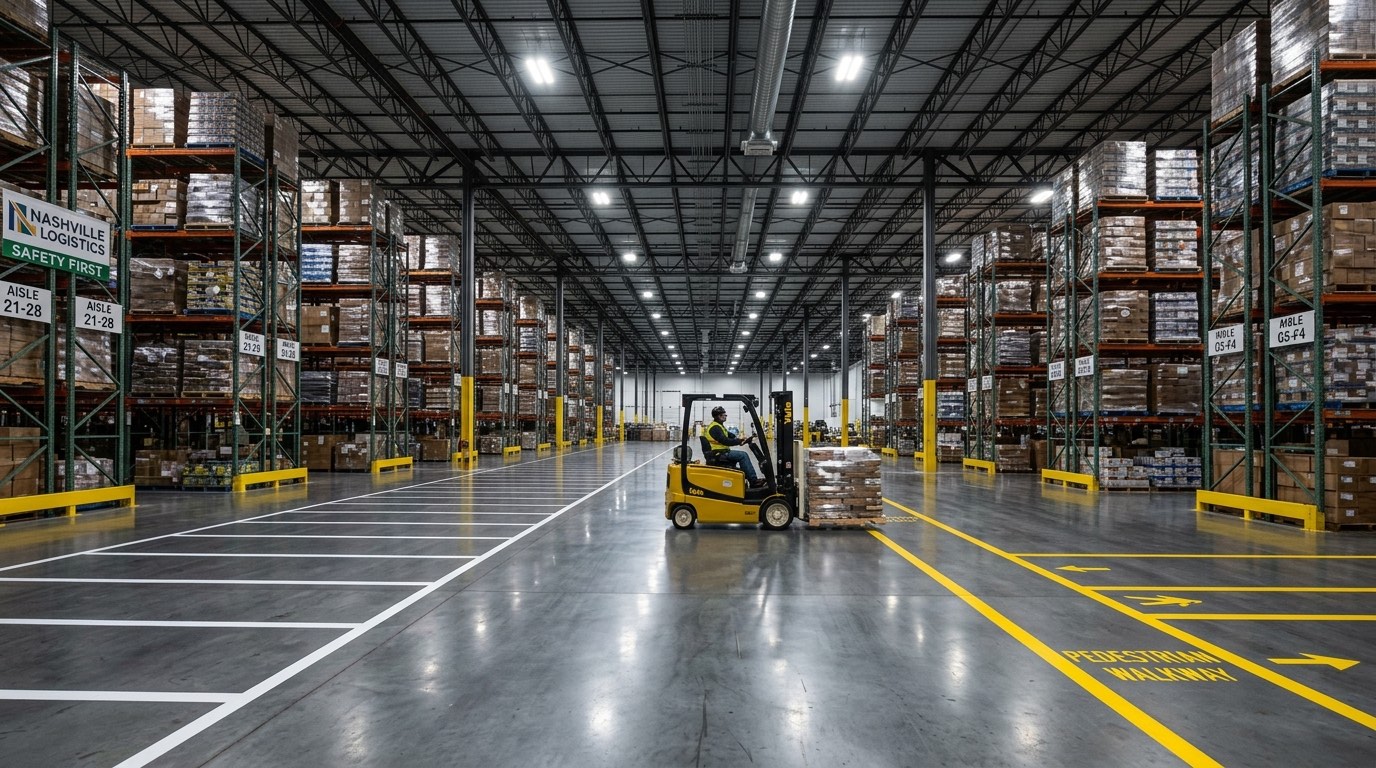
Warehouse epoxy flooring isn't spec'd the same way as a garage or showroom floor. A facility running loaded electric forklifts at 12,000 lbs GVW, pallet racking on 60-ft centers, and shift workers moving through the same aisles daily demands a system that starts with the right technical specification - not just the right color. Nashville's industrial sector has expanded significantly over the past decade; this guide covers what operations managers and facility directors actually need to know before signing off on a warehouse floor project.
Industrial Epoxy Specification for Nashville Warehouses
The two non-negotiable specifications for any forklift-traffic warehouse floor are solids content and dry film thickness (DFT). Everything else - color, aggregate, topcoat type - follows from getting these two right.
Minimum spec for forklift traffic: 100% solids epoxy at 20-mil dry film thickness. Water-based or 50–60% solids systems don't have sufficient abrasion resistance for loaded pallet truck or forklift traffic.
| Specification | Light Duty (hand carts, pedestrian) | Medium Duty (electric pallet jacks) | Heavy Duty (forklifts, loaded) |
|---|---|---|---|
| Solids content | Water-based OK (40–60%) | 70–85% solids minimum | 100% solids required |
| DFT (dry film thickness) | 8–12 mil | 12–16 mil | 20–30 mil |
| Surface prep (CSP) | CSP 2 | CSP 2–3 | CSP 3–4 |
| Topcoat | Polyurethane or none | Polyurethane | Polyaspartic or polyurea |
| Compressive strength | 7,000+ psi | 10,000+ psi | 12,000+ psi |
| Shore D hardness | 70–75 | 76–80 | 80–85 |
Forklift Load Ratings and Epoxy Floor Compatibility
Forklift damage to warehouse floors doesn't come from the forklift's rated capacity - it comes from the actual point load at the wheel contact patch. A 12,000-lb propane counterbalance forklift with a loaded attachment distributes weight across four wheels unevenly; the rear steer wheels can see 70% of total vehicle weight during tight turns.
For Nashville warehouse operators, the relevant questions are wheel type and turn radius:
- Polyurethane (PU) solid wheels - highest point load concentration, most abrasive to coatings. Require 25-mil DFT minimum in primary travel aisles.
- Cushion (vulcanized rubber) - moderate point loads, standard 20-mil spec sufficient for most applications.
- Pneumatic tires - largest contact patch, lowest point load. Can run on 16-mil systems in light-traffic areas.
- Pivot/turning zones - regardless of wheel type, these zones see dramatically elevated stress and should receive additional aggregate broadcast (#80 aluminum oxide) or extra topcoat passes in the 6-ft radius area around any fixed-position operation.
OSHA 1910.22 Safety Line Marking: Color Standards
OSHA regulation 1910.22 requires that permanent aisles and passageways be appropriately marked. While OSHA specifies that marking must be done, ANSI Z535.1 provides the industry-standard color convention that Nashville safety inspectors and third-party auditors use for evaluation.
Line Marking Application Method and Durability
Painted or taped floor markings fail quickly under forklift traffic - typically within 6–18 months in active Nashville facilities. The durable solution is epoxy-filled groove marking: a diamond grinder cuts a 1/8-inch-deep channel, which is then filled with colored epoxy that cures flush with the surrounding floor. These markings are nearly impossible to remove without grinding, last the life of the floor system, and pass OSHA inspection because they're permanent rather than applied-surface markings.
For facilities that require future reconfiguration flexibility, 100-mil epoxy paint stripes over a properly prepared base coat are the next-best option - significantly more durable than latex or alkyd line paint, with a 3–5 year service life under moderate forklift traffic.
Phased Installation: Keeping Nashville Warehouses Operational
The most common question from Nashville operations managers: can we keep running during installation? The answer is yes, with a phased approach. Here's the sequence we use for active Nashville warehouse installations:
Nashville Warehouse Epoxy Flooring Cost Guide (2026)
| Scope | Spec | Estimated Cost |
|---|---|---|
| Light-duty floor coating | 2-part epoxy, 10 mil, polyurethane topcoat | $2–3/sq ft |
| Medium-duty forklift system | 100% solids, 16 mil, polyurethane topcoat | $3–5/sq ft |
| Heavy-duty forklift system | 100% solids, 20–25 mil, polyaspartic topcoat | $4–7/sq ft |
| Safety line marking - painted | 100-mil epoxy stripe, per linear foot | $0.50–1.00/lf |
| Safety line marking - inlaid | Diamond-ground epoxy fill, permanent | $1.00–1.50/lf |
| Crack and joint repair | Epoxy injection or flexible urethane joint filler | $3–8/lf |
| Shot blast preparation | Included in above; standalone if slab only | $0.30–0.60/sq ft |
For context: a 50,000 sq ft Nashville warehouse spec'd at heavy-duty with inlaid line marking and ~2,000 linear feet of markings totals approximately $230,000–$380,000 depending on slab condition, coating system selected, and phasing requirements. Most active Nashville facilities land in the $4–5/sq ft range for a properly spec'd system.
Frequently Asked Questions: Warehouse Epoxy Nashville
ProEpoxy Nashville has installed epoxy floor systems in distribution centers, manufacturing facilities, and warehouses across Nashville and Middle Tennessee. Call (888) 275-7078 for a site visit and written specification - we'll evaluate your slab, document your forklift types, map your intended line marking layout, and provide a fixed-price quote before any work begins.